
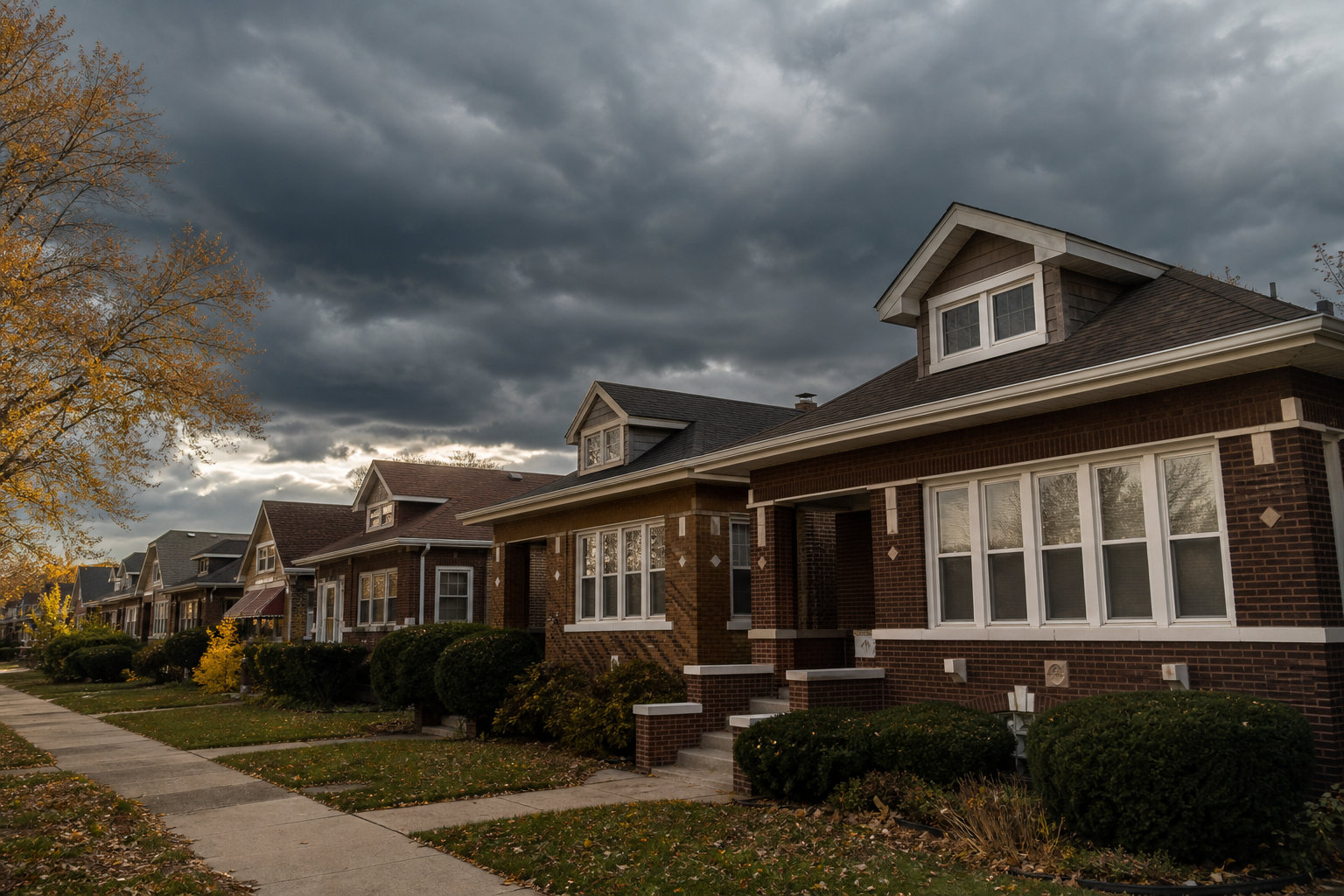

If you own a home in Chicagoland, or you’re budgeting to buy one, your insurance premium is the housing cost that behaves least like the others. A fixed mortgage rate stays fixed for the life of the loan. Property taxes move on a public schedule. Your insurance bill resets every year, and in Illinois it has been rising faster than incomes have grown. New state rules are coming, but not until July 2027. That means the renewals landing in your mailbox between now and then are still priced under the old rules.
What the Chicago Fed measured in Illinois insurance premiums
In a June 2026 analysis, researchers at the Federal Reserve Bank of Chicago worked through zip-code-level data covering roughly 80% of the homeowners insurance market. The Illinois numbers stand out even among neighboring states. The average premium rose from $1,366 in 2018 to $1,809 in 2022, a 32% jump that was second in the region only to Iowa’s 33% and well above the national average of about 26%. In Illinois, premium growth outpaced income growth over that period; in Michigan and Indiana, it didn’t.
The burden isn’t spread evenly. In 2022, households in Illinois’s lowest-income zip codes spent 2.9% of their income on homeowners insurance, nearly double the 1.5% spent in the highest-income zips. Those lower-income areas paid the second-highest premiums in dollar terms, not the lowest. The Fed’s analysis also links higher premium-to-income ratios to higher rates of policies cancelled for nonpayment. That relationship gets stronger in lower-income zip codes. One study cited in the analysis found borrowers with subprime credit pay about 30% more for the same coverage than those with the best credit.
One honest caveat: the Fed’s data ends in 2022. Everything that has happened to Illinois premiums since then, including the 2025–26 rate filings described below, sits on top of these numbers rather than inside them.
Why Illinois insurance rates have been an outlier
Illinois has long been an outlier in how insurance prices get set. Insurers here have been able to file new rates and start charging them immediately, with no requirement for state approval and no statute barring excessive rates. Consumer groups such as Illinois PIRG spent years criticizing that setup. The results showed up in renewal notices: State Farm raised Illinois homeowner rates by more than 27% in 2025, and Allstate filed increases totaling more than $58 million that took effect in February 2026, on top of over $100 million in hikes the year before. Reporting by WBEZ this spring tied the surge in part to climate-driven storm losses reaching the Midwest.
What Illinois’ new insurance law changes and leaves unchanged
In May 2026, Springfield passed HB 4273. Starting July 1, 2027, homeowners insurers must give 60 days’ notice before raising a renewal by 10% or more. They must base Illinois rates on Illinois loss data rather than shifting in costs from other states. The law also creates a new review: if the state finds a filed rate excessive, inadequate, or unfairly discriminatory, and that finding survives a hearing, the insurer has to rebate the difference to policyholders.
What the law does not do matters just as much. Insurers can still put new rates into effect the day they file them. Illinois remains a use-and-file state, with review happening after the fact. The law doesn’t cap increases, require pre-approval, or touch the underlying storm and rebuilding costs pushing rates up. Until July 2027, none of it applies at all.
Steps Chicagoland homeowners can take at renewal time
Know your ratio. The Fed’s affordability measure is simple: premium divided by income. In the Fed’s data, Illinois’s lowest-income zip codes averaged 2.9% in 2022, the range where the Fed observed cancellations climbing. If your own share is heading toward that range, treat it as a budget line to manage rather than background noise.
Shop each renewal. Rates reset annually, and the new review rules don’t take effect until July 2027. The filing cycle between now and then runs entirely under the old system. A renewal notice gives you a reason to compare quotes.
Watch the escrow effect. If your insurance is escrowed with your mortgage, a premium hike shows up as an escrow shortage and a bigger monthly payment, even though your loan rate never moved. That’s the mechanism behind “my fixed mortgage payment went up.”
Don’t let a payment lapse quietly. The Fed’s cancellation data shows that nonpayment cancellations cluster where premiums bite hardest. A cancelled policy can become a mortgage problem as well as an insurance problem. Lenders require coverage, and if a policy lapses, the lender can buy replacement coverage on your behalf and bill you for it.
Sources and data behind this analysis
- Federal Reserve Bank of Chicago, Chicago Fed Insights: Polacek & Newberger, “Homeowners Insurance Premiums and Cancellations in Seventh District States” (June 2026; NAIC PCMI data, 2018–2022)
- Insurance Journal and InsureReinsure: Illinois HB 4273 provisions and effective date (May 29, 2026)
- Illinois PIRG: Allstate 2025–26 rate filings
- WBEZ: climate drivers of Illinois premium increases (March 27, 2026)
Figures verified against the sources above as of July 16, 2026. Spot an error? Corrections come first. Human-guided and edited — about this desk.