
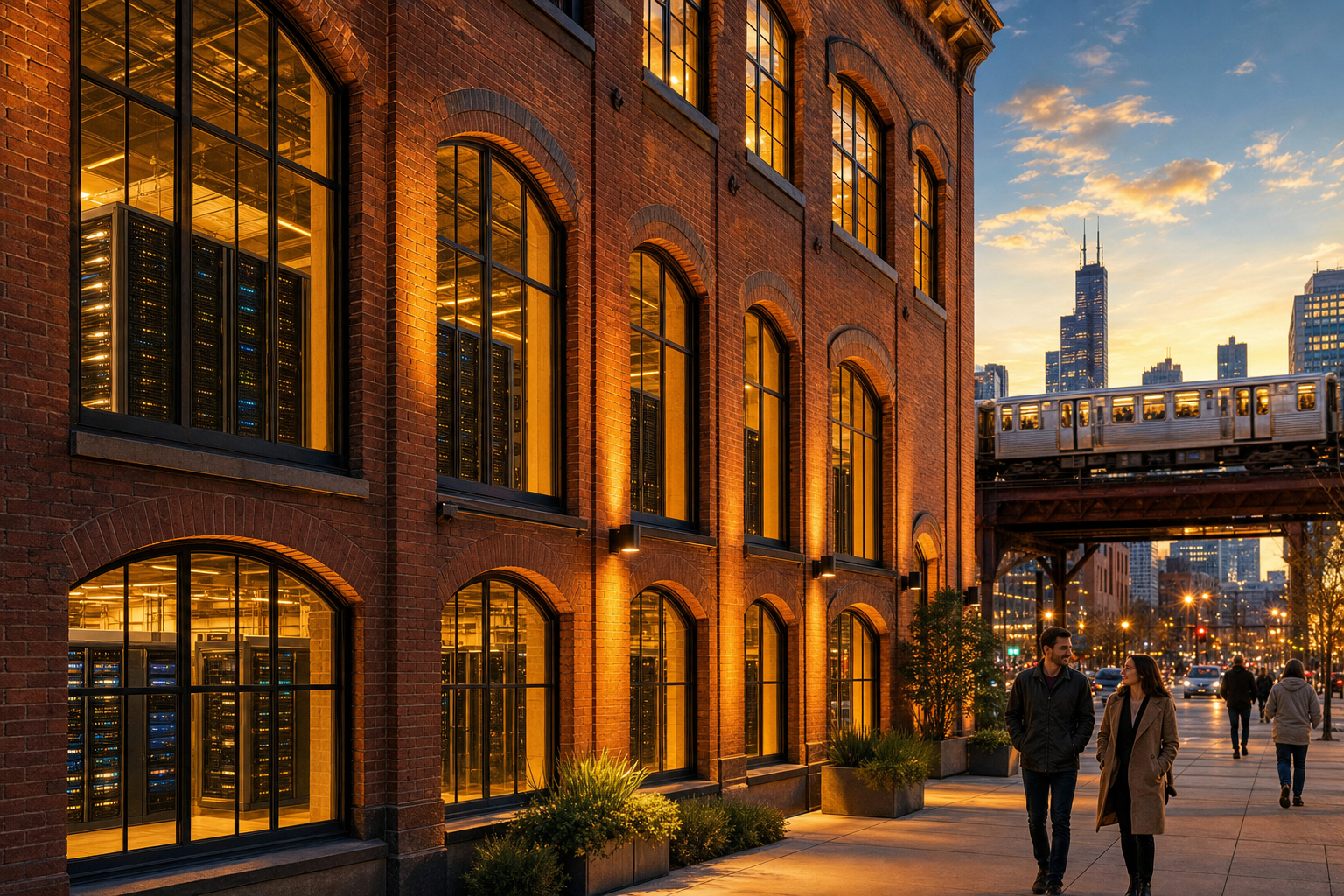

Across the country, governments are debating pauses on data-center construction — and some have enacted them. Chicago’s own permit file shows a decade of steady approvals: 92 data-center permits since 2015 carrying $492 million in reported construction cost — including a seven-story office building the city cleared this July for conversion into one.
92 permits screened and classified · $480M of the reported cost sits on 48 major capital permits · 2015 through late July 2026A data center is a building full of computing equipment — the physical home of cloud services and, lately, of artificial-intelligence training. The buildings draw large amounts of electricity, and many designs cool with large amounts of water; since the start of 2026, fourteen states and more than one hundred local governments have considered pausing or banning them. Chicago’s building-permit file records this city’s own version of the story: every permit since 2015 whose description mentions a data center, from giant purpose-built server buildings down to closet-sized server rooms inside ordinary offices. We read and classified all 92. A permit is permission to build, not a finished facility, and this file covers the City of Chicago only — suburban data centers sit outside it.
What the file shows: steady work, a few big swings
The cadence is steady — between four and twelve data-center permits every year since 2015 — and the money arrives in swings. The largest single permits: a $50.8 million, 254,170-square-foot addition of server-hall space to an existing facility in 2016; a $65 million four-story new build permitted in 2019; tenant build-outs of $18 million to $21 million apiece filling that four-story building’s floors in 2020, 2023 and 2025; and this month’s $51.1 million conversion. Alongside the big swings sit 44 small permits — fire alarms, wiring, cooling-unit swaps, server rooms inside ordinary buildings — that together report under $12 million and mostly describe upkeep at facilities that already exist.
Two conversions, eleven years apart, tell the story
The bookends of this file are both conversions. In 2015, a permit authorized converting a 317,000-square-foot, two-story newspaper production facility into a data center — a building made for printing presses, cleared to hold servers instead. In July 2026, a permit authorized phase two of converting a seven-story office building to a data center — at $51.1 million of reported cost, the second-largest single permit in the file, though a permit means the work may begin, not that it is finished. Our transit reporting has measured the emptier post-pandemic downtown from the ridership side; this is one office building the permit file shows changing use entirely. One conversion is not a trend, and we are not calling it one.
While other governments pause data centers, Chicago keeps issuing permits
The national context makes Chicago’s continued approvals notable. By a June count in the trade publication Bisnow, read in full for this piece, fourteen states had considered data-center moratoriums since the start of 2026. Some pauses, the roundup reported, were enacted rather than just proposed: New York passed a one-year statewide pause, and Charlotte, Denver and Tulsa enacted pauses of their own — Charlotte’s for 150 days, Tulsa’s for nine months. It counted roughly fifty Michigan counties that enacted or considered bans, and more than one hundred localities weighing restrictions. Opposition, Bisnow wrote, is proving “a fruitful position for politicians across the political spectrum.” Chicago’s permit file, for its part, shows issuance continuing: by late July 2026 the city had issued four data-center permits, every one of them a major capital permit, carrying $73.5 million in reported cost — the office conversion the largest. A permit file records permits, not politics; whether any pause is being debated at City Hall is a question this data cannot answer.
How we counted
- Source: the city’s building permits file (ydr8-5enu), permits issued January 1, 2015 or later whose work descriptions mention a data center — 92 permits, each read and classified. Retrieved July 28, 2026.
- The classification: 48 major capital permits — anything the city’s own permit type calls new construction; descriptions of erecting building shells or adding server halls (“data halls” in permit language); build-outs and alterations reporting $1 million or more; and conversions — and 44 minor permits (equipment, wiring, fire alarms, server rooms inside other buildings). The minor bucket keeps small permits at existing facilities from being counted as new capacity.
- The money: reported construction cost is the figure the applicant puts on the permit. It is not audited, eight permits report none, and permit cost is not the same as total project investment; the sums here are floors, not totals.
- The boundary: this file covers permits issued by the City of Chicago. Data centers in the suburbs are outside it, and this page makes no claim about them.
- The national count: Bisnow’s June 14, 2026 national roundup of moratorium activity, read in full. Other coverage of individual local fights exists; we cite only what we read.
- What this is not: a market analysis or a forecast. It is a count of what one city’s permit file records, while the national argument runs.
Computed by KCM Desk from Chicago building-permit records, 2015 through July 28, 2026; published July 28, 2026. If you spot an error, corrections come first.
Related Keep Chicagoland Moving coverage
- Chicago Has Permitted 78 Office-to-Apartment Conversions Since 2015. Nearly Half Came Since the Start of 2024.
- No State’s Residential Electricity Prices Rose Faster Than Illinois’: Up 28 Percent in a Year, Per the Federal Table
- Chicago Issued 698 New-Construction Permits in the First Half of 2026. Here’s Where They Went.
- Chicago Licenses 1,000 Fewer New Businesses a Year Than Before the Pandemic. The Gap Is Downtown.
- Riding the Red Line, 2001–2026: Every Station, One Scroll