
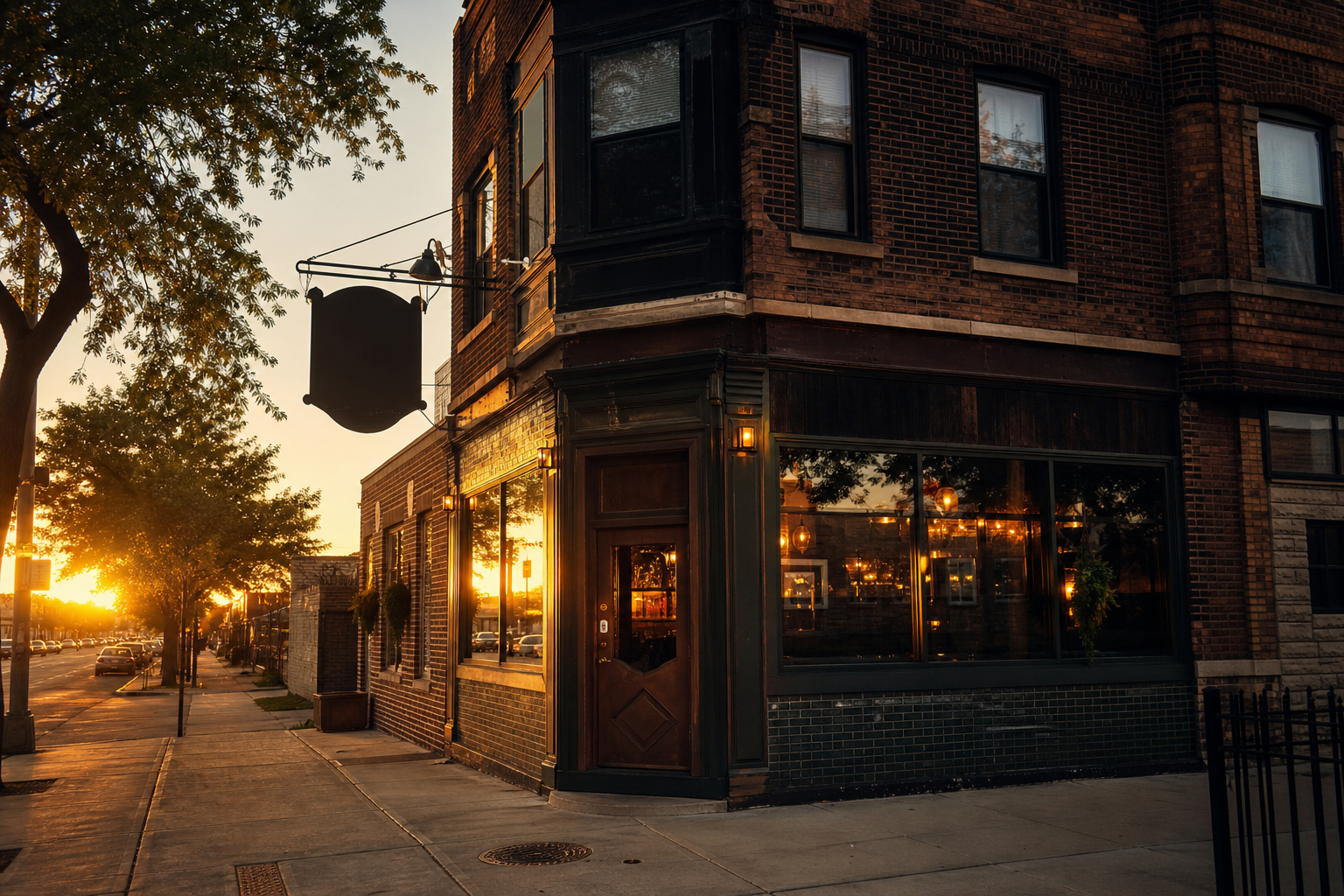

On July 1, 2003, Chicago’s license file shows 1,386 premises holding an active tavern license. On July 1 of this year it shows 758 — a loss of 45 percent, spread across almost every year in between. A tavern license is the city’s permission to sell liquor for drinking on the premises; a package-goods license covers liquor sold to take away — and premises licensed for package goods moved the other way, from 1,005 to 1,053, with 2013 the first July in the file with more of them than licensed taverns. Every July since has repeated it.
Business Licenses, Chicago data portal · retrieved August 8, 2026 · active licenses on July 1 snapshots, 2003–2026Reading a license correctly
The business-license file records license terms — an initial issue, then renewals — not businesses, so this page dedupes its 38,781 tavern and package-goods rows to licensed premises: distinct account-number-and-site-number pairs, the same unit our sidewalk-café analysis uses. A premises counts as active on a date when that date falls inside a license term and the license’s recorded status allows it: the file documents its own codes — cancelled during the term, revoked, revocation under appeal — each stamped with a status-change date, and a license whose cancellation or revocation date has passed stops counting. What no license row can say is whether the door was open: the file records permission to operate, not operation. A licensed tavern can sit dark for a season and look identical here to one pouring every night.
The slide, in five Julys
- 2003the file’s first full year1,386
- 2013first July behind package goods1,029
- 2019870
- 2021876
- 2026this July758
The decline runs at about 27 premises a year and it is old: more than half of the drop — 1,386 down to 1,029 — had already happened by 2013. The stretch people might expect to be the cliff is instead the flattest in the file: 870 licensed taverns in July 2019, 873 in 2020, 876 in 2021. A held license says nothing about whether a bar was open or serving through those two years — only that its owner kept the permission alive. The slide resumed after: 814 by 2022, and 758 now.
Package goods crossed over in 2013
Premises licensed for package goods barely moved across the same 23 years: 1,005 in July 2003, 1,053 in July 2026, never far from that band in between. The two lines crossed in 2013 — 1,067 to 1,029, the first July in the file where takeaway outnumbered on-premises — and the gap has widened every time the tavern count stepped down. This July it is 1,053 to 758. The file offers no reason, and this page does not guess at one: licenses measure permission, and these two kinds of permission have simply gone in different directions.
Five areas hold 289 of the 758
- Lake View77100
- Near North Side6588
- West Town6181
- Logan Square4449
- Lincoln Park4272
- Belmont Cragin44 → 16
- Brighton Park33 → 9
- Lower West Side31 → 7
- Portage Park37 → 14
- South Lawndale31 → 9
Of the 77 community areas, 68 hold fewer licensed taverns than in 2003, eight hold the same, and exactly one holds more: Rogers Park, 17 then, 18 now. The five areas with the most today — Lake View, the Near North Side, West Town, Logan Square, Lincoln Park — hold 289 of the 758 among them; each holds fewer than in 2003 but kept its base. The largest declines outside those five run through the Northwest, West, and Southwest Sides: Belmont Cragin went from 44 licensed taverns to 16, Brighton Park from 33 to 9, the Lower West Side from 31 to 7, Portage Park from 37 to 14, South Lawndale from 31 to 9. In proportion the losses run deepest in that direction too — Austin kept 5 of its 24 and Englewood 1 of its 16, while no top-five area fell below half of its 2003 count. Areas with no active tavern license at all went from three in 2003 to ten this July. And in three areas — North Lawndale, Woodlawn, and Kenwood — the file shows five or more premises licensed for package goods and none licensed as a tavern: the permission to sell liquor to take away exists there; the permission to serve it on the premises does not.
Known limits
Twenty of the 38,781 rows carry no license-start date and never enter a snapshot; three rows carry the revocation-under-appeal status and are treated here like revocations from their status-change date. A few premises per snapshot carry no location code — at most two tavern and six package-goods — and sit in citywide totals only. The city’s separate current-liquor file, deduped the same way, held 754 tavern premises at retrieval — four fewer than this page’s July 1 snapshot, taken 38 days earlier. Nothing here measures drinking, revenue, or whether any licensed premises was open on any date.
- Sources Business Licenses (r5kz-chrr, 2002 to present, rows updated August 2, 2026) and Business Licenses — Current Liquor and Public Places of Amusement (nrmj-3kcf, validation only), retrieved August 8, 2026.
- Counting License descriptions ‘Tavern’ and ‘Package Goods’ only. A premises = a distinct (account number, site number) pair; the site number is a per-account sequence, so neither field alone identifies a location. Active on July 1 of a year = that date falls between the row’s license start and expiration dates, excluding rows whose documented cancellation, revocation, or appealed-revocation status-change date had already passed. The first snapshot is 2003, the file’s first full year; 2002 is partial and unused.
- Geography The portal’s computed community-area column stores internal region codes, not area numbers. The code-to-area crosswalk was derived from the city’s 311 file (v6vf-nfxy), which carries both columns: each of the 77 codes was assigned the community area that over 95 percent of that code’s 2026 311 rows name, with names from the city’s boundary dataset (igwz-8jzy).
Computed by KCM Desk from records retrieved August 8, 2026. Human-guided and edited — about this desk. If you spot an error, corrections come first.
Related Keep Chicagoland Moving coverage
- How Chicago Works, by the Numbers
- Chicago Deep Dish, by the Record: Born Fall 1943, With a Creator the Reference Work Never Names — and 2,445 Active Licenses With PIZZ in the Name
- The Chicago Community Areas With the Most Licensed Taverns
- Chicago’s Sidewalk Cafés Are Nearly Back to Their 2019 Count. The Loop Is at 75 Percent.
- After a Chicago Restaurant Is Found Out of Business, a New Food Business Shows Up in Inspection Records at 56 Percent of Addresses Within Two Years