

Chicago’s administrative-hearings ordinance-violation file holds 841,271 rows — but they are charge lines, repeated across hearing dates, describing 144,837 hearing dockets, and this page counts dockets. Two findings sit on top of that ledger. First, despite the dataset’s general name, every docket in it was issued by one department: Buildings — the file is the building-code hearing docket. Second, the arc: dockets collapsed to 1,755 in 2020, then climbed back to 10,701 in 2025, the busiest year in the file since 2010. About 44 percent of all dockets carry at least one imposed fine — but the file records no formal disposition: fines appear line by line, and a disposition column does not exist.
Ordinance Violations, Chicago data portal · 841,271 rows describing 144,837 dockets · retrieved August 20, 2026, file updated dailyOne docket, many charge lines
The file logs one row per violation charge at a hearing date, and a case with two dozen charges heard three times can run past a hundred rows — the largest docket carries 144 charge-line rows. Collapsed to distinct docket numbers, the ledger holds 144,837 cases, at 5.8 rows apiece on average. One boundary to hold onto: this is the Department of Administrative Hearings’ docket file, not the Building Violations dataset our inspection analyses read — that file records violations inspectors write; this one records cases that reached a hearing docket. The two are different systems and are never combined here.
One name, one department
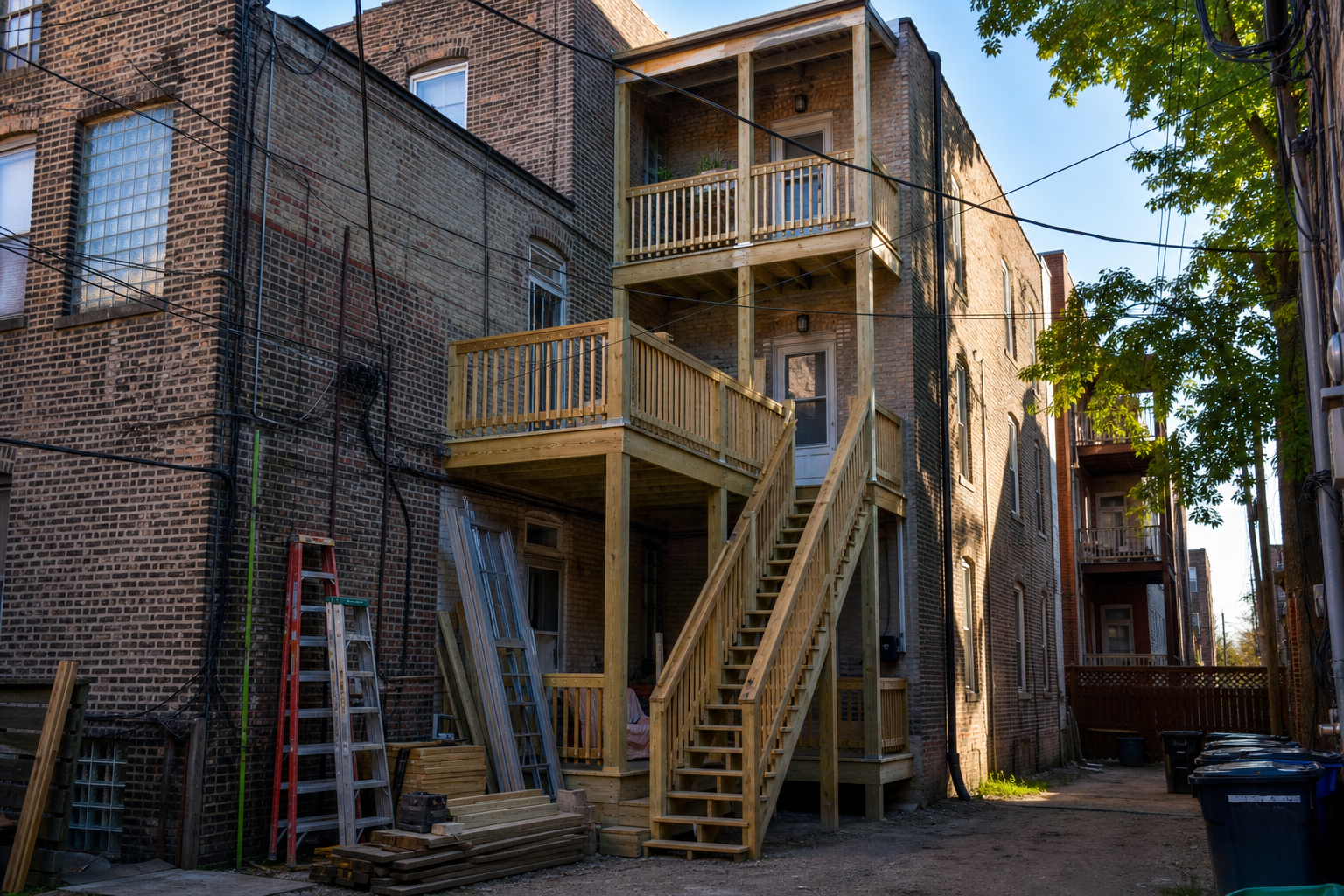
The dataset presents itself as the list of ordinance violations filed with the Department of Administrative Hearings, and its issuing-department column takes exactly one value across all 841,271 rows: Buildings. Whatever other departments bring to administrative hearings, none of it is in this file — a fact about the file’s contents, reported as such. The charges read accordingly: the most common, on 39,062 dockets — 27 percent — is the order to arrange an inspection of the premises, followed by porch repairs (24,644 dockets), exterior walls (24,158), posting the owner’s information (21,394), and smoke detectors (13,375). A docket can carry many charges, so these counts overlap and are not a partition.
The arc, and the file’s calendar noise
- 2008(the file’s peak)15,106
- 20135,833
- 20197,798
- 2020(the collapse)1,755
- 20233,236
- 2025(busiest since 2010)10,701
- 2026(through the August retrieval)5,773
Dated by violation date, the file runs at full scale from 2008 — its 15,106-docket peak — through a long slide, a pandemic-era floor of 1,755 dockets in 2020, and a climb to 10,701 in 2025, more than any year since 2010’s 10,989. The calendar also carries noise, reported rather than smoothed: 46 dockets have no violation date, 55 carry years before 2000 — one reads the year 119 — 74 sit in the sparse 2000–2006 ramp, 22 carry years after 2026, one of them 6111. And 88 dockets carry violation dates in two calendar years: they appear in each of those years’ counts but only once in the overall 144,837, which is why the year figures sum slightly above the total.
The fine column, and why this page does not sum it
Each charge line carries an imposed-fine value, and the same charge recurs across hearing dates with the fine sometimes zero at one hearing and not the next. The file states no rule for collapsing those repeats, so any dollar total computed from it would be a guess dressed as arithmetic — this page prints none. What can be counted honestly is simpler: 64,402 of the 144,837 dockets, about 44 percent, carry at least one charge line with an imposed fine above zero. An imposed fine is a hearing’s recorded assessment, not money collected, and the file says nothing about payment.
Known limits
The hearing’s formal outcome is not here: the file carries no disposition column, and its own description directs disposition questions to the Department of Administrative Hearings directly. The respondents named in the file are private parties; this page never reads that column. Docket counts measure cases filed, not buildings, owners, or outcomes; imposed fines are assessments, not collections; and the one-department finding describes this file’s contents, not the universe of the city’s enforcement, which other systems record. The file updates daily; every figure is a snapshot of the August 20, 2026 retrieval.
- Source Ordinance Violations (6br9-quuz, Chicago data portal), 841,271 rows retrieved August 20, 2026. All queries were server-side aggregates; the respondents column was never selected.
- Counting Every figure counts distinct docket numbers (144,837), never rows; the charge-line row inflation (5.8 rows per docket on average) is disclosed above. Year figures use the violation-date year, with undated, pre-2000, 2000–2006, and post-2026 dockets bucketed and disclosed; the 88 dockets with violation dates in two years appear in each year’s count and once in the overall total. Charge-type figures count dockets mentioning each description, so they overlap. The imposed-fine column is not summed, for the reason stated in the body; the fined-docket count includes any docket with at least one line above zero. Percentages are computed from raw counts.
Computed by KCM Desk from records retrieved August 20, 2026. Human-guided and edited — about this desk. If you spot an error, corrections come first.
Related Keep Chicagoland Moving coverage
- How Chicago Works, by the Numbers
- The 8 Orders Chicago’s Building-Code Hearing Docket Issues Most, From 144,837 Cases
- Chicago’s Environmental Complaints, Inspections and Enforcement Files Each Split at January 1, 2012 — and the Older Half of the Complaints and Inspections Files Records No Outcomes at All
- Six Years On, Which 2019 Building Violations Are Marked Complied?
- Chicago Still Budgets 200 Building Inspectors. It Writes Half as Many Violations as in 2018.