
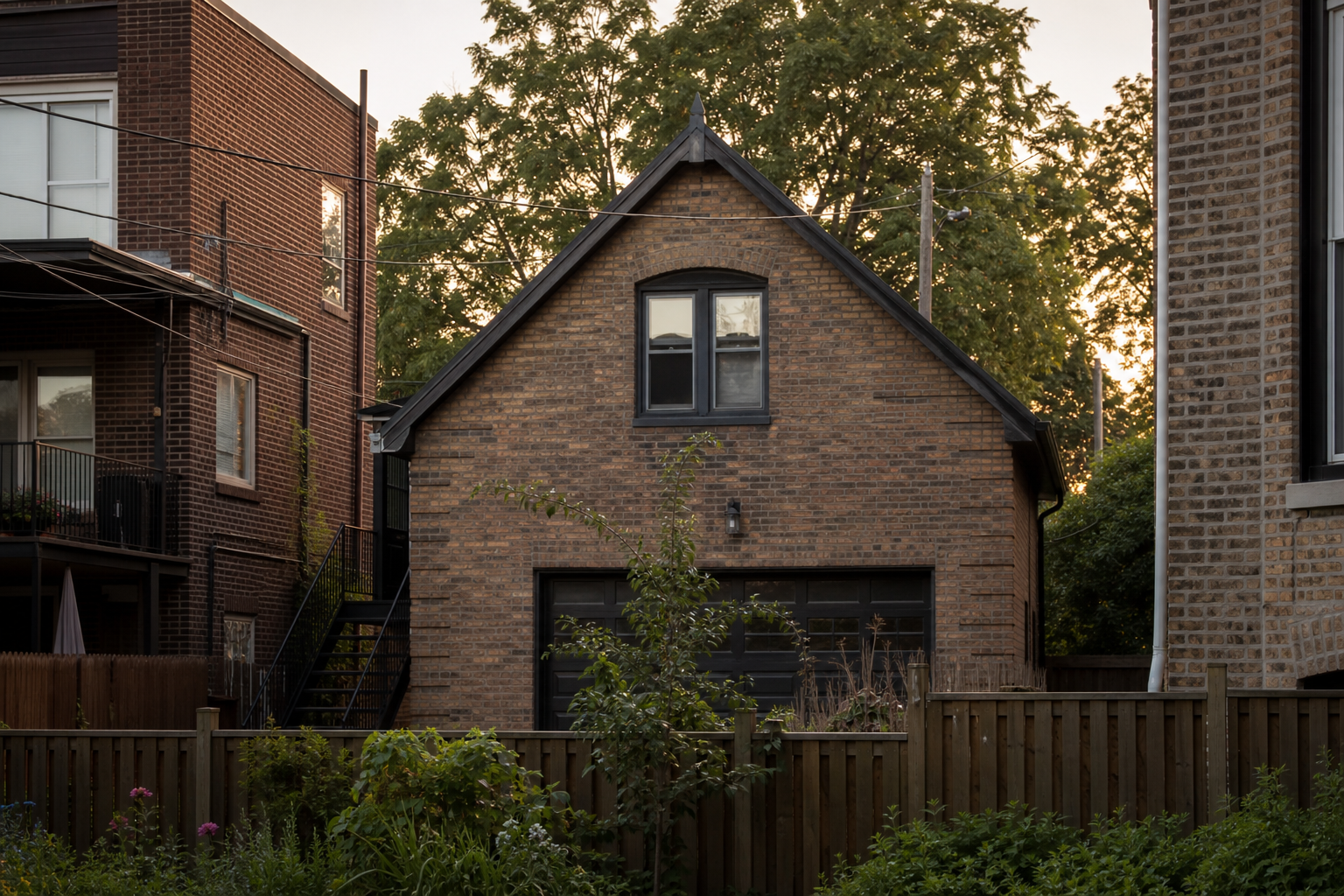

Did Chicago’s expansion of additional dwelling units — coach houses and basement or attic apartments — bring more applications? The city’s own application files show more of them since it took effect, though they cannot say why: its new preapproval file logged 495 applications between March 31 and September 14, 2026, including 215 in April alone, more than the retired file it replaced recorded in any full year from 2022 through 2025. The new applications come from 42 wards; the old file’s nearly five years of applications came from 25.
Additional Dwelling Unit Preapproval Applications (j4h8-ug9m), 495 rows, submitted March 31 through September 14, 2026, refreshed and retrieved September 15, 2026 · the retired historical file it replaced (xbwc-ntpx), 1,038 rows, May 1, 2021 through March 16, 2026 · both read for aggregate columns only — applicant and owner names, addresses and coordinates were never pulled · the two files use different forms and status words, so every comparison between them is labeledTwo files, one program
Chicago re-legalized additional dwelling units, or ADUs, in a 2020 ordinance that opened pilot areas starting May 1, 2021. On September 25, 2025, the City Council voted 46–0 to extend the program beyond them — while giving alderpeople power to restrict ADUs in newly eligible areas, a design Illinois Answers examined — and Block Club reported the expanded program live on April 1, 2026. The city’s data portal tracks the step before construction, a preapproval — a pre-certification, in the new file’s status words and on the city’s ADU page — which the dataset description says must be followed by a building permit from the Department of Buildings. That record now sits in two files. The historical one, 1,038 applications from May 1, 2021 through March 16, 2026, was retired in a portal notice dated May 11, 2026; its replacement begins March 31, 2026.
| Month | File | Applications |
|---|---|---|
| October 2025 | Old file | 9 |
| November 2025 | Old file | 10 |
| December 2025 | Old file | 12 |
| January 2026 | Old file | 11 |
| February 2026 | Old file | 6 |
| March 1–16, 2026 | Old file | 6 |
| March 31, 2026 | New file | 1 |
| April 2026 | New file | 215 |
| May 2026 | New file | 78 |
| June 2026 | New file | 67 |
| July 2026 | New file | 65 |
| August 2026 | New file | 45 |
| September 1–14, 2026 | New file | 24 |
Did April’s pace last? Not at April’s level: after 215 in April, monthly applications ran 78, 67, 65 and 45 through August — each month still well above the old file’s busiest month of 2025, which had 16.
Where the applications come from now
Do the applications now reach more of the city? In wards, yes. The new file’s applications come from 42 of the city’s 50 wards; the old file’s 1,038 came from 25. Seventeen wards that never appear in the old file — 4, 5, 7, 8, 9, 11, 12, 15, 25, 29, 30, 37, 38, 39, 43, 45 and 49 — account for 121 of the new applications, 24.4 percent, and no ward appears in the old file without appearing in the new one. Zoning moved too: 43 new applications sit on business or commercial zoning classes, where the old file had none — every one of its rows carried a residential class and a zone label, led by Northwest (421) and North (408). The file does not say whether any alderperson has restricted ADUs in a ward, so a ward without applications is only that.
| Ward | New file, March 31–Sept. 14, 2026 | Old file, May 2021–March 2026 |
|---|---|---|
| 26 | 38 | 10 |
| 1 | 31 | 162 |
| 32 | 31 | 63 |
| 35 | 30 | 113 |
| 24 | 24 | 36 |
| 6 | 20 | 17 |
| 29 | 20 | 0 |
| 33 | 20 | 52 |
| 40 | 18 | 104 |
| 44 | 18 | 51 |
How fast, and how often approved
How long does a preapproval take now? A median of 9.3 days from submission to the date the file assigns an application its current status, across the 446 pre-certified applications — and 3.9 days for those submitted in July, and again for August. In all, 446 of 495, or 90.1 percent, read pre-certified, 9 of them with an “admin adjust” note; 6 were denied; 15 were canceled, spelled both “Canceled” and “Cancelled”; 22 still read Submitted; and 6 carry other in-process statuses, such as In Review and Upload missing information. The old file’s 816 issued preapprovals took a median of 14 days by its date-only fields; it recorded 82 denials, with 140 more left at a documents-requested status. Among applications with a decision, 1.3 percent were denied in the new file and 9.1 percent in the old one — our arithmetic, across status words that differ between the files.
What the applications seek to build
Conversion units — basement, attic or other units inside the main building — still lead: 318 new applications include one, against 196 that include a coach house, with 22 asking for both and 3 marking neither. The old file, which recorded one type per application, counted 705 conversion units and 333 coach houses. Most new applications seek a single unit, 467 of 495; 22 seek two or more, one records zero and five leave the count blank; 21 carry an affordable-unit requirement, which the file’s column note ties to owners adding two or more ADUs. And 318 new applications are marked owner-occupied, 64.2 percent, against 536 of 1,038, or 51.6 percent, in the old file — a comparison across two differently worded forms.
Who fills out the form
The property owner filed 340 of the new applications. The other 155 name the submitter’s role in a free-text box, which we grouped: 81 list an architect, 34 an expediter — spelled “expeditor” in 16 and “expediter” in 18 — 26 another representative such as a contractor, manager or attorney, 7 a family relationship, 3 a buyer and 4 something else. These are counts of applications, not of distinct people.
A preapproval is not a permit
Does a preapproval mean an ADU gets built? Not by itself. The city’s ADU page says a pre-certification “does not automatically guarantee that your project is permissible,” and every project still needs Department of Buildings permits before construction begins. This site’s count of ADU building permits found 201 from May 2021 through late July 2026; the old preapproval file alone records 816 issued preapprovals over nearly the same years. The two records cannot be matched here application by application — this page reads no addresses — so the gap compares totals and says nothing about any single project.
What the files confirm, and what they cannot tell you
Confirmed, as filed: each application’s submission date, status and the date that status was assigned; its ward and zoning class; the unit types and counts sought; owner occupancy; and, in the old file, a zone label. What no column we read holds: whether a unit was built; why an application was denied or canceled; why a ward has few or no applications; and whether any alderperson restricted ADUs anywhere. No ward, alderperson or applicant is judged here.
Where the record lives
The new application file and the retired historical file sit on the city portal, beside the retirement notice; the city’s ADU page carries the program rules. Every figure drawn from the two preapproval files recomputes from them as retrieved September 15, 2026, and the new file updates as applications arrive; the permit count, the Council vote and the program dates come from the sources linked above.
The bottom line
Asked whether Chicago’s ADU expansion brought more applications, the city’s application files show more of them since: 495 in five and a half months, 215 in April alone, from 42 wards, 17 of them new to the record, with 90.1 percent pre-certified at a median of 9.3 days. They record timing, not cause — the new file began the same week the expanded program went live. Whether those preapprovals become built units is a question for the permit record, not these files.
Two more questions the files can answer
Which ward leads the new file? Ward 26, with 38 applications; it had 10 in the old file. And which led the old file? Ward 1, with 162, and Ward 47, with 153 — in the new file they have 31 and 16.
- Sources: the city’s Additional Dwelling Unit Preapproval Applications (j4h8-ug9m, 495 rows) and its retired historical file (xbwc-ntpx, 1,038 rows; its Issued view holds 816), retrieved September 15, 2026.
- Columns read: submission and status dates, status, ward, zoning class, unit types and counts, affordable-unit requirements, owner and owner-occupancy flags, prior-application flag and submitter role; in the old file, its zone label and type fields. Applicant and owner names, mailing and project addresses, coordinates and the alderperson field were never pulled.
- Our groupings: submitter roles into architect, expediter, family member, buyer, other representative and other; zoning classes beginning B or C as business or commercial, R as residential; “with a decision” as pre-certified (both status words) or denied in the new file, issued or denied in the old one.
- Timing: new file, the status-assignment timestamp minus the submission timestamp; old file, the status-updated date minus the submission date.
- Not here: no individual application, address or person; no judgment of any ward, alderperson, applicant or of the program.
Computed by KCM Desk from the city’s ADU preapproval application files, retrieved September 15, 2026. Human-guided and edited — about this desk. If you spot an error, corrections come first.
Related Keep Chicagoland Moving coverage
- Chicago Housing, by the Numbers
- Chicago Re-Legalized ADUs in May 2021. It Has Issued 201 ADU Permits Since, Fewer Than One a Week.
- The New Federal Housing Law: Four Provisions That Reach Chicago, Measured Against Our Records
- Chicago Issued 698 New-Construction Permits in the First Half of 2026. Here’s Where They Went.