
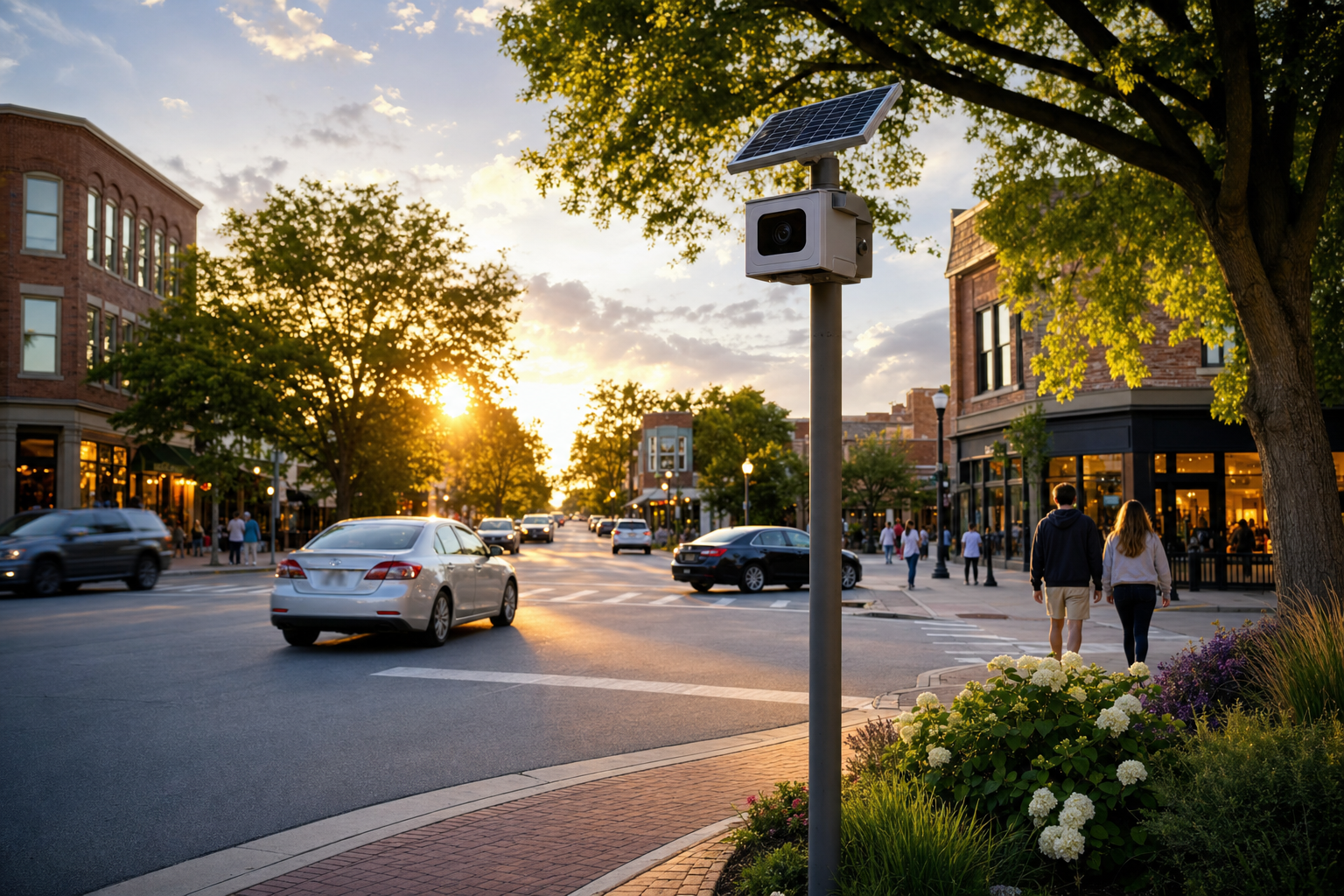

Twice last year, the Illinois Secretary of State’s audits found U.S. border agents with access to Illinois license-plate camera data, in violation of a state law written for exactly that. The cameras behind that fight sit all over Chicagoland: across the six counties, at least 116 police agencies have documented use of cameras from Flock Safety — operator of what the state’s audit announcement calls the nation’s largest plate-reader system — and one suburb’s own disclosure page shows its cameras can be searched by 463 organizations, from the Chicago Police Department to Wisconsin’s Department of Justice to a freight railroad’s police force.
222 Illinois agencies counted from the Electronic Frontier Foundation’s Atlas of Surveillance · state law, two audit announcements and two camera-network disclosure pages read in fullAn automated license plate reader, or ALPR, is a camera — on a pole or a squad car — that photographs passing vehicles’ plates and checks them against whatever wanted-vehicle lists and law-enforcement databases the operating agency has connected. Flock Safety sells these camera systems to police departments and, crucially, connects them: a department can let other agencies search its cameras, and join searches of theirs. That sharing is what Illinois law now regulates, what the Secretary of State audited, and what this piece counts.
What Illinois law says the cameras cannot be used for
Since January 1, 2024, the Illinois Vehicle Code has a section written for exactly this technology: Section 2-130, read in full for this piece. It forbids a camera operator from selling, sharing, allowing access to or transferring plate-reader data for the purpose of investigating or enforcing a law that denies or interferes with the right to choose or obtain reproductive or other lawful health care services, or a law that permits detaining or investigating a person based on immigration status. Before sharing with an out-of-state law enforcement agency, the operator must first obtain a written declaration that the data will not be used in the ways the section forbids. The section’s definition of a plate reader covers privately owned cameras too, to the extent their data is shared with police.
What the state’s audits found last year
The Secretary of State’s office, which administers that law, audited a sample of 12 local police agencies’ Flock data sharing. Its August 25, 2025 announcement, read in full, said the audit found U.S. Customs and Border Protection had gained access to Illinois plate cameras — through a Flock pilot program the announcement says Flock’s own leadership was unaware of. The office ordered that access shut off; Flock paused the pilot nationwide. A second announcement on September 5, also read in full, reported border agents reaching plate data from Forest Park in suburban Cook County — through cameras run not by Flock but by Motorola Solutions — a second vendor, and a reminder that Flock is not the only network. Nothing in either announcement, or in this piece, says any of the counted agencies broke the law: the first finding faulted a vendor-run pilot; the second faulted one village’s sharing configuration.
What two suburbs’ own disclosure pages show
Flock publishes a voluntary “transparency portal” for agencies that opt in, and the portals are the closest public window into how the cameras run day to day. We read two Chicagoland portals in full. Hoffman Estates’ page (as displayed July 28) listed 78 cameras, a 30-day data-retention period, and 4,153 alerts against wanted-vehicle lists in the prior 30 days. McHenry’s page (as displayed July 29) reported 275,720 vehicle detections in 30 days, 173 user search sessions — and a list of 463 organizations granted access to its data. That list includes the Chicago Police Department, the Illinois State Police, the Cook County Sheriff, Metra’s police, 29 Wisconsin agencies, the Indiana State Police, a Kentucky police department, Norfolk Southern railroad’s police force, and three entries the portal labels federal: the U.S. Postal Inspection Service, the police at Indiana Dunes National Park, and Wright-Patterson Air Force Base in Ohio. Both portals list prohibited uses; both name immigration enforcement. Only Hoffman Estates’ list also names lawful health care services — the portals are written per agency, and they differ.
How we counted
- The agency count: the Electronic Frontier Foundation’s Atlas of Surveillance dataset, downloaded July 28, 2026 (15,072 rows nationwide). We counted rows where the state is Illinois, the technology is automated license plate readers, and the vendor includes Flock: 222 distinct agencies statewide, 116 in Cook, DuPage, Kane, Lake, McHenry and Will counties. The Atlas is built from news coverage, agency documents and public-records requests, each row dated; the Illinois Flock rows carry dates from June 22, 2020 to September 11, 2025.
- What the count is not: a live census. It documents that use was recorded at some point; an agency may have since dropped Flock, and an agency using Flock may be missing from the Atlas. It is also Flock-only: other vendors — including Motorola Solutions, named in the September audit finding — serve other agencies, including the Chicago Police Department.
- The law: Illinois Vehicle Code Section 2-130 (Public Act 103-540, effective January 1, 2024), read in full. The audit announcements: the Illinois Secretary of State’s August 25 and September 5, 2025 news releases, read in full at ilsos.gov.
- The portals: the Hoffman Estates and McHenry transparency portals, read in full on July 28 and 29, 2026; figures are what each page displayed on that date, and the pages update continuously. A third portal we attempted was blocked by the site’s bot check. Portals exist only for agencies that opt in.
- What this is not: an accusation. Nothing here says any counted agency violated any law, and the state’s findings concerned vendor-level and single-agency data-sharing configurations, not the everyday use of the cameras. It is a count of a system’s documented footprint.
Computed by KCM Desk from the EFF Atlas of Surveillance, Illinois statute and audit records, and Flock’s public transparency portals; published July 29, 2026. Human-guided and edited — about this desk. If you spot an error, corrections come first.
Related Keep Chicagoland Moving coverage
- Cameras Watching Chicagoland, by the Numbers
- Chicago’s Speed Cameras Recorded 2.6 Million Violations in the Year Through June. One Camera Averaged 415 a Day.
- Chicago’s Red-Light Cameras Are the Quieter Program: 537,706 Violations in the Latest Year, Led by Lake Shore and Belmont
- Data Centers Face Pauses and Bans Elsewhere. Chicago’s Permit File Shows $492 Million in Reported Construction Since 2015.