
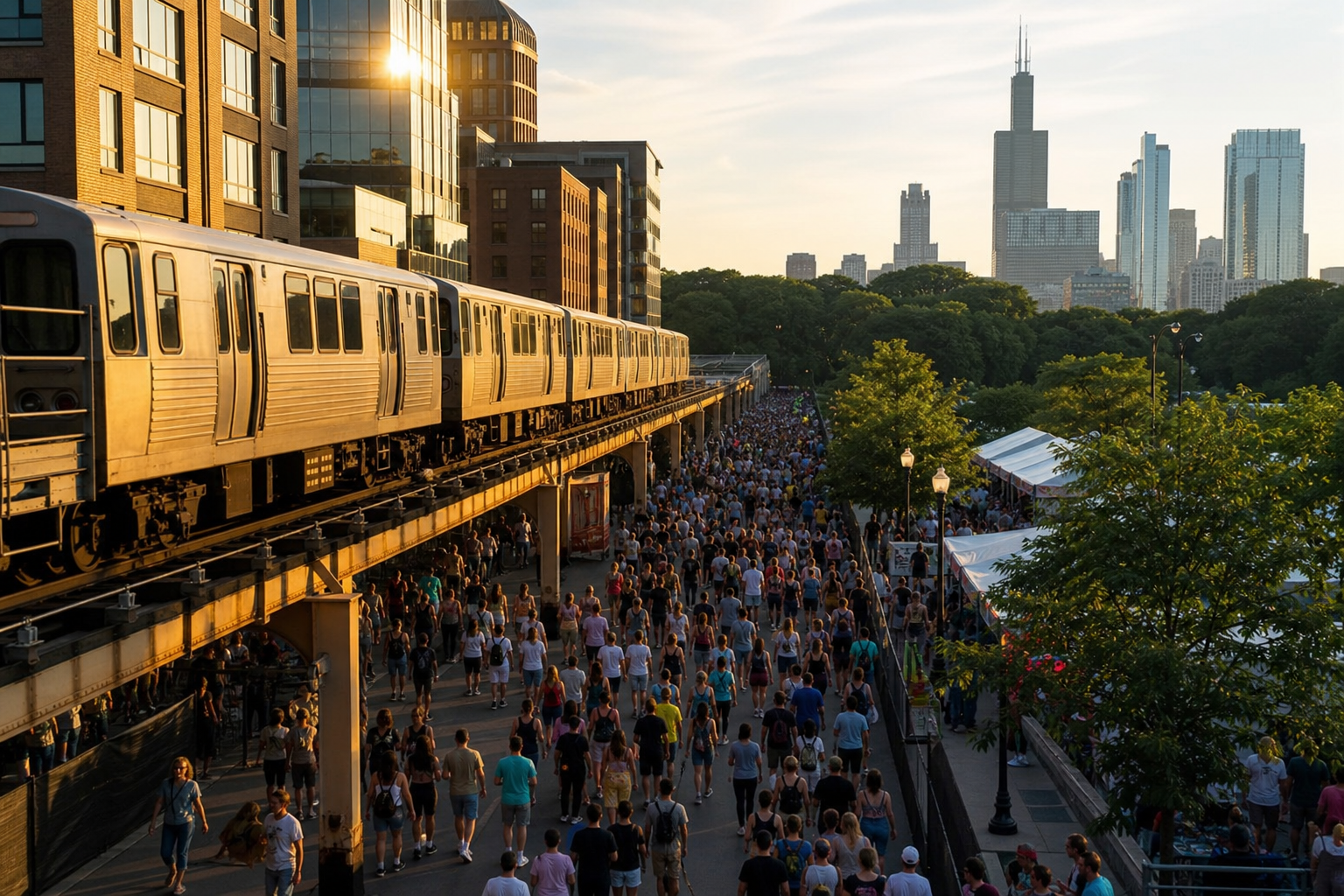

You’ve got the wristband sorted. The decision you can control is how you get to Grant Park and, more importantly, how you get home at 10pm with a hundred thousand other people. Lollapalooza 2026 runs Thursday, July 30 through Sunday, August 2, and the transit agencies have now published their festival service plan. Here is what CTA, Metra and Pace are actually running, what it costs, and the rules that will affect your ride.
The 2026 service plan: extra Metra trains, longer Yellow Line hours
The agencies announced the plan on July 23. From Thursday, July 30 through Sunday, August 2, Metra will run extra trains on seven of its eleven lines and add cars to others for capacity; the festival-weekend schedules are posted at metra.com/schedules, so check your line there rather than assuming your usual timetable. On the CTA side, the Red and Blue lines and the elevated Loop lines are the workhorses, and Yellow Line service — the Skokie branch — runs extended hours until 1am each night of the festival. Pace, the suburban bus agency, will drop off and pick up its ADA Paratransit riders at Columbus Drive and Monroe Street, and its regular suburban routes connect to CTA and Metra rail as usual.
One line in the announcement matters beyond this weekend: the agencies say this coordinated festival service reflects the goals of the NITA Act, and that starting this fall the new Northern Illinois Transit Authority will take over coordinating service around major events. This is the last Lollapalooza planned under the old three-agency arrangement.
Rail stations and bus connections near Grant Park
Grant Park sits near more rail than almost any festival site in America. From the Red Line, exit at Monroe, Jackson, or Harrison and walk east. The Blue Line drops you at Monroe, Jackson, or LaSalle. The Loop elevated lines, Brown, Orange, Green, Pink, Purple, put you a few blocks away at Adams/Wabash or the Harold Washington Library stop.
Coming in on Metra, both downtown terminals connect to the park by CTA bus, and the 2026 route list is slightly shorter than in past years. From Union Station, take the #126 Jackson, #130 Museum Campus, or #151 Sheridan. From Ogilvie Transportation Center, take the #20 Madison, #56 Milwaukee, or #J14 Jeffery Jump. CTA and Metra will post signboards at both stations pointing riders to the right buses, and the buses serving the festival will carry Lollapalooza signs in their windows.
What the ride costs, including two new Metra passes
Transit fares are frozen for 2026; the agencies confirmed no increases this year after the state’s transit funding deal. A CTA ride is $2.25 by bus or $2.50 by train with any contactless card or phone, and the unlimited passes are $5 for one day, $15 for three days, and $20 for seven. Metra sells a $7 Day Pass for unlimited Saturday or Sunday travel, and two newer options through the Ventra app, the region’s fare app: a $10 Weekend Pass covering unlimited Metra rides across the whole system on both Saturday and Sunday, and a Regional Day Pass add-on that puts unlimited CTA and Pace travel on top of a Metra Day Pass for an extra $2.50. If you are riding in from the suburbs for both weekend days, the $10 Weekend Pass is the cheapest way to do it.
Search interest suggests parking remains the bigger question for attendees: Google keyword volumes show “lollapalooza parking” drawing roughly eight times the searches of “lollapalooza metra” (390 versus 50 monthly, per Google Ads data pulled July 16, 2026). We won’t quote parking prices because they vary by lot and surge with events. Transit fares are public and fixed, and the train avoids post-headliner traffic.
The rules that will affect your ride
Metra says tickets will be checked all weekend, and on outbound trains riders may be asked to show a ticket before boarding at the downtown stations — buy in the Ventra app or at a vending machine before you get in line, and keep your phone charged. Riders are asked not to bring backpacks or water bottles on Metra trains during the festival, matching the festival’s own bag rules. Metra also warns that crowded trains may not accommodate bicycles and that conductors can refuse boarding to bicyclists. Around the park itself, expect the usual phased street closures — Michigan Avenue closes near Grant Park during the festival — which reroute a dozen-plus bus routes; if your regular commute uses a Michigan Avenue bus, plan around it.
One more thing that most festival guides skip: if anyone in your group is a senior, has a disability, or receives SNAP benefits, Chicagoland’s reduced-fare programs apply to festival travel like any other ride. We covered who qualifies and how to enroll here.
Sources and data for this guide
- CTA/Metra/Pace joint service announcement, July 23, 2026: extra trains on seven Metra lines, Yellow Line 1am hours, 2026 bus connections, pass prices, ticket and bag rules, the Pace ADA pickup point, and the NITA coordination note
- Lollapalooza: 2026 dates and lineup (official site)
- CTA Lollapalooza destination page: rail and bus access to Grant Park
- NBC Chicago: 2026 fares held flat after the transit funding bill
- ABC7 Chicago: 2026 street closures around Grant Park
- Google Ads keyword volume data via DataForSEO, pulled July 16, 2026: “lollapalooza parking” (390/mo) vs “lollapalooza metra” (50/mo)
Updated July 27, 2026 with the agencies’ official 2026 service plan, announced July 23 — fulfilling the update this page promised at publication. Spot an error? Corrections come first. Human-guided and edited — about this desk.