
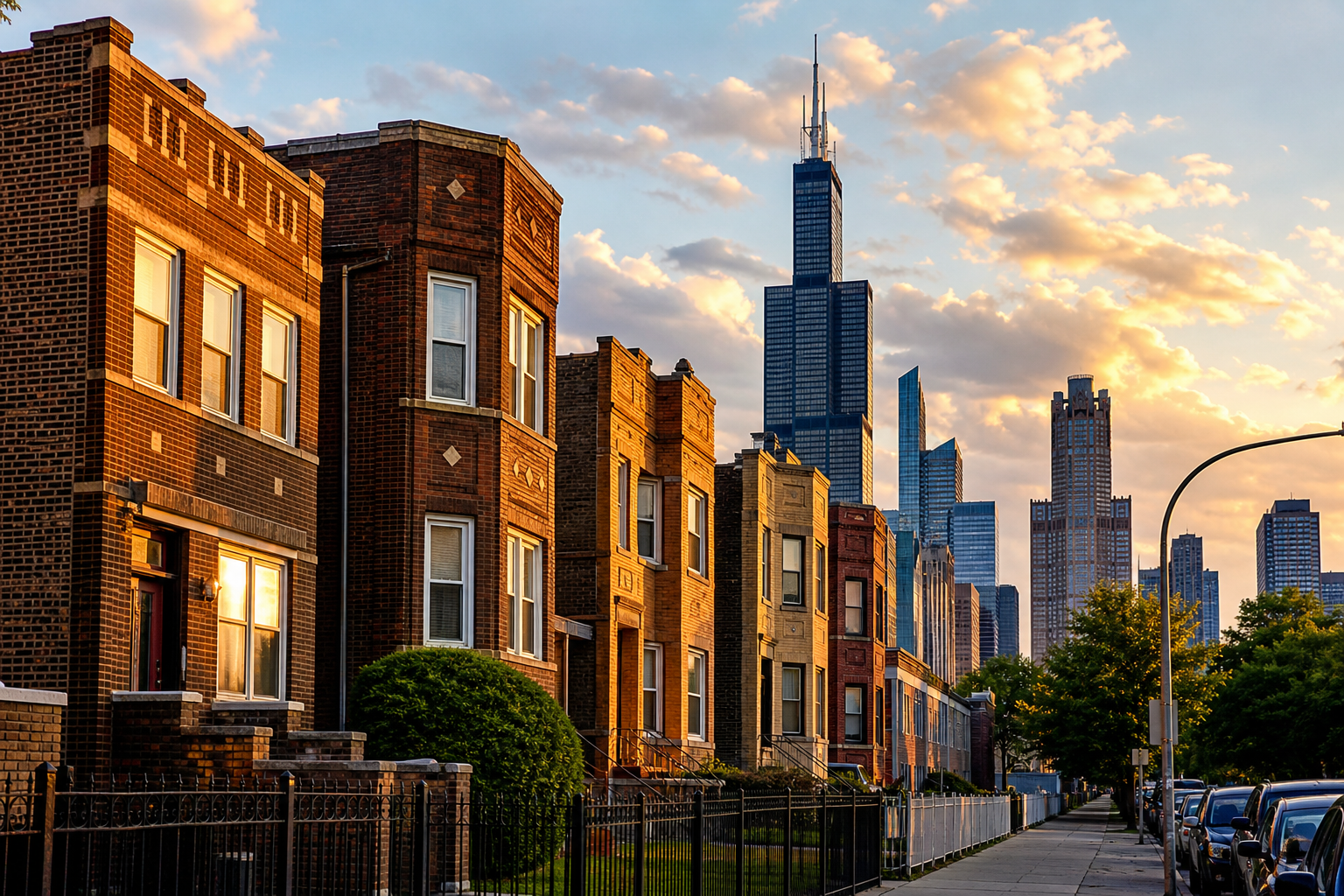

Chicago’s skyline gets talked about in superlatives, and most of them float free of any document. Here are eight height records with the receipts attached: the Encyclopedia of Chicago (a Chicago Historical Society and Newberry Library work), building pages from the Chicago Architecture Center (an independent nonprofit), the Metropolitan Water Reclamation District — a separate government, not a city department — and the city’s own building-footprint file, 820,606 rows we queried ourselves. This page takes no position on which tower deserves your affection; it reports what the record shows, and where a figure is our own computation it says so.
1. The first height record: Chicago raised its streets four to five feet, on average
Before this city built up, it jacked up. The Encyclopedia of Chicago’s street-grade entry records streets “raised by an average of between four and five feet” “in two stages, in 1855–56 and 1857–58” so the flat lakebed town could drain — buildings and all, hotels included, screw-jacked to the new grade. It is documented, and we walked the below-ground half of this story in 7 Things Under Chicago.
2. Among the world’s first skyscrapers: LaSalle and Adams, 1885 — and it’s gone
The Chicago Architecture Center’s page on the Home Insurance Building states it was “Completed in 1885 on LaSalle Street between Adams and Monroe” and “among the world’s first skyscrapers,” with “Architect William LeBaron Jenney” on the record. The address line carries the ending in parentheses: “135 S. La Salle Street (demolished).” The building itself was demolished — the Center’s page is the receipt.
3. 110 stories — and the world’s tallest for nearly 25 years
The Center’s Willis Tower page: “Standing 110 stories tall,” and “For nearly 25 years after its completion, the Willis Tower, formerly known as the Sears Tower, held the title of tallest building in the world,” with “Original Completion Date 1974” on the building card. The city’s own footprint file agrees on the number: its stories column tops out at exactly 110, as the Center records.
4. The 2020 arrival: 1,198 feet, third-tallest at completion
The Center’s page on The St. Regis Chicago says the tower did not merely arrive — it “oust the Aon Building as the 3rd tallest building in Chicago when it was completed in 2020” (their phrasing, kept whole). It was “designed by acclaimed architect Jeanne Gang of Studio Gang Architects,” “Reaching a height of 1198 feet” in three stacked stems “at increasing heights resembling cell phone signal bars.” A skyline that started with a ten-story insurance office now files its newcomers at a thousand-plus feet — receipt here.
5. The most common story count in the city’s building file: two
Our computation, from the city’s Building Footprints file retrieved September 1, 2026: of the 427,998 footprint rows that carry a story count, the biggest single class is two stories — 198,439 rows — edging the 191,840 one-story rows, with 37,719 at three or more. The median footprint with a recorded story count: two stories. The skyline in the photographs is the exception: two-story rows are 46 percent of every counted row — nearly one in two. (The file’s other 392,608 rows record zero stories or none — counted out, and said so.)
6. Forty stories is rare air: 128 footprints, then 5, then 2
Same file, same date, our arithmetic, and the same exclusion of zero-or-blank story rows: 128 footprint rows record 40 stories or more. Climb to 70 and the count falls to 5. At 100, it is exactly 2. In a file of 820,606 footprints, the 40-story-and-up class is 128 rows — about one footprint in every 6,400 — and the hundred-story club is a pair.
7. The city’s own file still says SEARS TOWER
Those two hundred-story rows carry names, and the names are a time capsule: the 110-story footprint, filed with the address range 205–233 S. Wacker, is named SEARS TOWER, and the 100-story footprint at 875 N. Michigan is named JOHN HANCOCK CENTER — printed here exactly as filed. The Center’s own page notes the first tower is “formerly known as the Sears Tower”; the city’s file, as retrieved, still carries the earlier names.
8. The story keeps going 300 feet down — and it isn’t the city’s
Chicago’s height story keeps going below the basement. The Metropolitan Water Reclamation District — its own government — describes its Tunnel and Reservoir Plan as “totaling 110 miles of tunnels, 8 to 33 feet in diameter and 150 to 300 feet underground.” Two documented reference points, then, from two of the pages cited here: a 1,198-foot tower above one street, and a tunnel system running as much as 300 feet underground — MWRD’s page holds the low end.
Questions people actually ask
Which Chicago building has the most stories?
By the city footprint file’s stories column — subject to that file’s own coverage — the answer is the row filed as SEARS TOWER: the column tops out at 110 in exactly that one row. The Chicago Architecture Center’s Willis Tower page records the same 110-story count, and its near-25 years as the world’s tallest. This page ranks by stories, not feet; feet-measured rankings belong to the sources.
Was the first skyscraper really built in Chicago?
The Chicago Architecture Center records the Home Insurance Building, completed in 1885 at LaSalle and Adams, as among the world’s first skyscrapers — a qualified claim, quoted as the Center makes it — and notes on the same page that the building was demolished. The claim has receipts; the building itself is gone.
How many 40-story-plus footprints does the city’s building file hold?
In the city’s Building Footprints file as retrieved September 1, 2026, 128 footprint rows record 40 stories or more — excluding the 392,608 rows whose story value is zero or blank. Five rows reach 70 stories; two reach 100.
Method, sources and corrections
Quotes are verbatim from the linked pages, fetched and checked September 1, 2026: the Encyclopedia of Chicago street-grade entry, the Chicago Architecture Center’s Home Insurance Building, Willis Tower and St. Regis Chicago pages, and MWRD’s TARP page. Story counts are our queries of the city’s Building Footprints file (syp8-uezg, 820,606 rows): counts group the file’s stories field, and every story figure excludes the 392,608 rows where stories is 0 or empty — reproducible with a count over that field and that filter, the exclusion stated where the counts appear. Building names are printed as the file prints them. Human-guided and edited — about this desk. If you spot an error, corrections come first.
Related Keep Chicagoland Moving coverage