
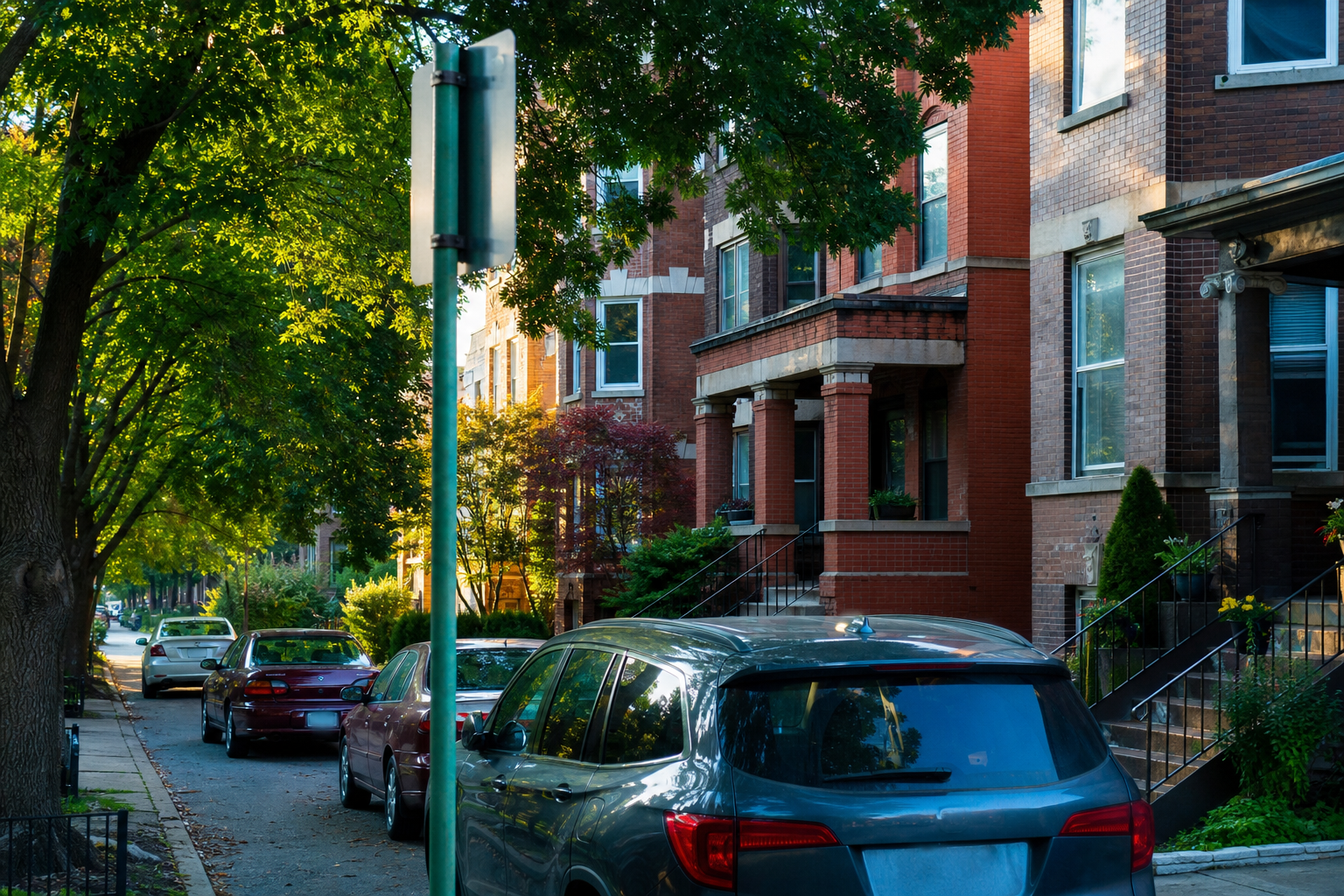

Why does your block need a residential parking permit while the next street over doesn’t? Chicago’s answer lives in a file: the city’s permit parking is assembled from 1,937 active zones, and “Residential Parking Zones are established by passage of legislation through the Chicago City Council.” Zone by zone, block-side by block-side. Read whole — all 10,392 street-segment rows, each one a single side of a single stretch of one street — the file runs small: the median active zone spans exactly 2 segments, 238 zones are one segment long, and at the other pole sits zone 383, with 653 active segments to its name. Strangest of all: 1,382 active segments — one in seven — are “buffer” rows, where by the file’s own definition “Buffer means that physical signs do not exist for that zone on that physical street,” yet residents “shall have the privilege to purchase zone products (daily permits and annual passes) for that zone, as if physical signs were installed.” On those stretches the zone’s rights run where that zone’s own signs do not. The legislation, not the metal, is the zone.
Parking Permit Zones (u9xt-hiju), 10,392 street-segment rows — one per zoned side of an address range — retrieved August 29, 2026; the whole file was downloaded and every figure recomputed · 9,889 rows ACTIVE, 503 RESCINDED · permit prices and rules are the City Clerk’s to state, on the Clerk’s zone-parking pageTwo thousand tiny territories
The numbers run from zone 1 to zone 5050, and the map they draw is not the tidy patchwork the word “zone” suggests. The file warns you itself: a zone’s segments “closer resemble a collection of intersecting segments rather than an unbroken area.” Our derivation from the full roster: the median active zone is 2 segments — one side of two stretches, or both sides of one — and 238 zones consist of a single segment, a lone block-side with its own legislation behind it. Meanwhile zone 383 runs 653 active segments and zone 143 runs 520. The same legal instrument produces a single block-side and a 653-segment sprawl, and the file holds both without comment.
Half odd, half even — and yes, one side of your street can be zoned
Every segment carries a side: 4,946 active rows bind the odd-numbered addresses and 4,943 the even — an almost perfect split. Which raises the question people actually type into search bars: can the permit rule really apply to one side of the street and not the other? Yes, and measurably: pairing each zone with each street it touches, 614 of the 3,616 active zone-street combinations — 17 percent — carry only one side of the street. A zone is a bundle of block-sides, and plenty of those bundles hold a side without its opposite.
The invisible zones
The file’s buffer mechanic deserves more fame than it has. On 1,382 active segments — 14 percent of the active file — “Buffer means that physical signs do not exist for that zone on that physical street,” and yet the residents of those addresses “shall have the privilege to purchase zone products (daily permits and annual passes) for that zone, as if physical signs were installed.” Our reading, labeled as ours: the buffer is the system’s unsigned margin — addresses folded into a zone’s permit-purchase rights without that zone’s signage, so the right to buy a permit outruns that zone’s metal on those poles. Whether any particular stretch carries buffer status is written in the file itself, linked below, row by row.
Where the zones cluster
Count active segments by ward: Ward 43 leads with 600, Ward 44 with 471, then Wards 1 (389), 2 (378), 25 (354) and 30 (349). Our derivation: the top two wards alone hold 1,071 active segments — one in nine citywide, in two of Chicago’s fifty wards. Why the map tilts that way, the file does not record — it logs legislation, not parking pressure — and we leave the why open. The most-zoned street names are quieter than you’d guess: Harding (92 active segments) and Springfield (91) sit atop the street table — segment counts, not lengths. And 202 active segments span two wards at once, which anyone who has watched a Chicago ward map will find entirely in character.
Zones die, too
The file keeps its graveyard: 503 segments sit at RESCINDED, and 118 zone numbers that appear in the file no longer have a single active segment. Zones are established by Council legislation, per the file’s own description; the RESCINDED column is the ledger’s other direction, and it holds both halves of the story. Whatever your block’s status today, somewhere in these 10,392 rows is the zone record that made it so.
- Source: the city’s Parking Permit Zones file (u9xt-hiju): 10,392 rows, one per zoned street segment (a single side of an address range), retrieved August 29, 2026. The whole file was downloaded and every figure on this page recomputed from it; the quoted lines are the portal description’s own words.
- Two offices: zones are created and changed by City Council legislation, per the file’s description; residential permits themselves are administered by the City Clerk’s office, whose zone-parking page is linked above. No permit price, eligibility rule, or enforcement claim appears on this page.
- Counts: “active” means a row’s status column reads ACTIVE; zone counts are of distinct zone numbers among those rows. Median zone size is computed over active segments per zone. Street figures are counts of segments, not lengths.
- Readings: the buffer-as-courtesy reading is ours, labeled where it appears, and it does not go beyond what the rows and the description state; derivations (median zone size, shares, the two-ward concentration) are arithmetic on the full file.
Computed by KCM Desk from the city’s parking-zone file, retrieved August 29, 2026. Human-guided and edited — about this desk. If you spot an error, corrections come first.
Related Keep Chicagoland Moving coverage
- When Does the Street Sweeper Come? Chicago’s 2026 Schedule Holds 8,545 Section-Sweep Dates, 2,721 Still Ahead — and Two Sections Booked 66 Times
- How Chicago Works, by the Numbers
- Chicago’s Parking-Meter Deal, From the Documents: More Than $1.15 Billion Up Front in 2009, $161 Million in True-Up Payments Through 2024 — and a Sale the City Council Approved 46 to 3, on Conditions
- Chicago Keeps a Do-Not-Dig List: 14,093 Active Street Moratoriums, Doubled Permit Fees After Repaving — and One Stretch Protected Until 2207
- Did You Know? Chicago, by Its Own Records