
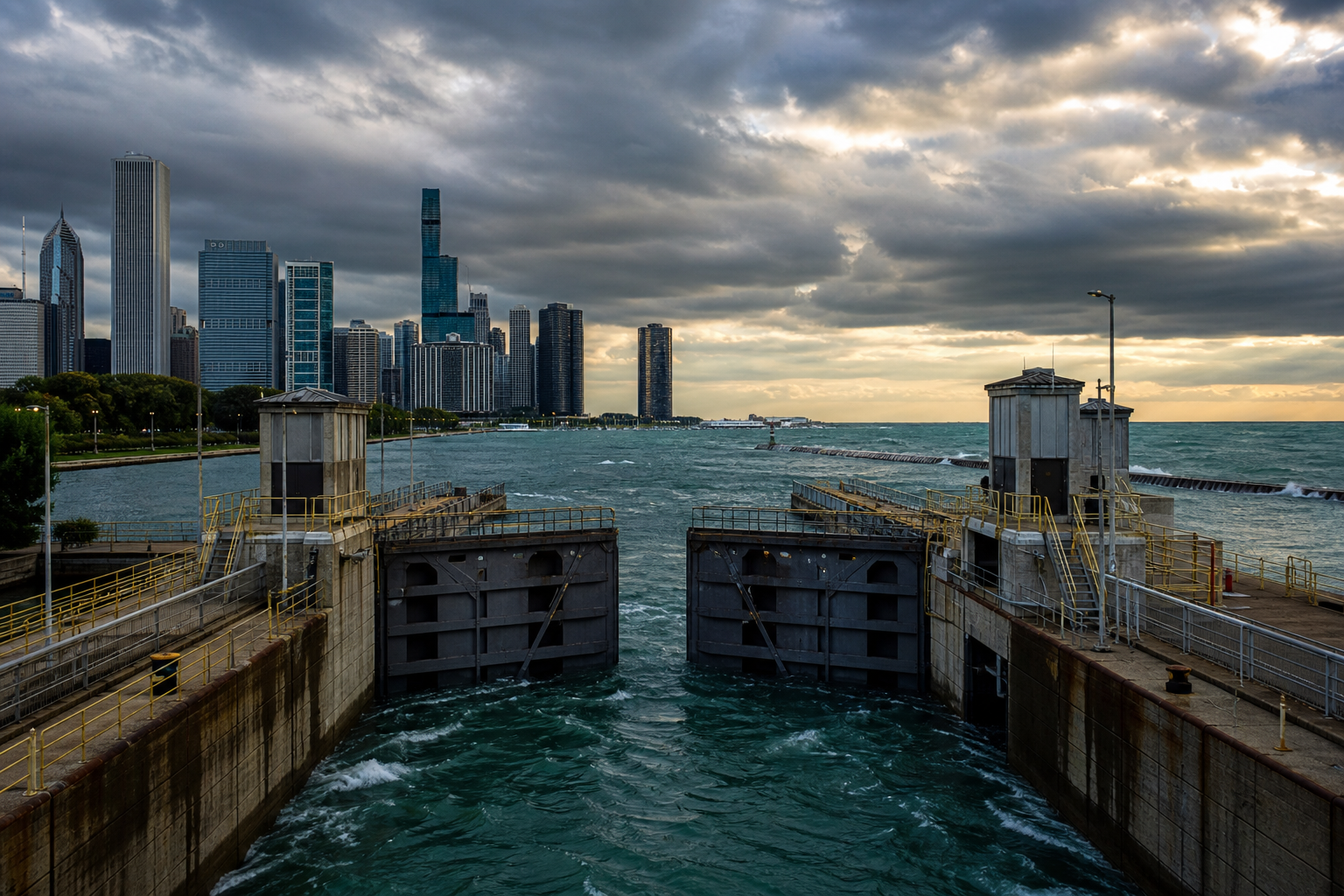

Chicago reversed its river. That part of the story is true, and the Metropolitan Water Reclamation District — a separate agency from the city, and the one that did it — states it plainly: the district “reversed the Chicago River in 1900 by constructing the Chicago Sanitary and Ship Canal to take wastewater away from Lake Michigan.” The part the story leaves out is in the district’s own log. Its posted table of “Reversals to Lake Michigan (1985–Present)” lists 36 occasions since 1985 on which the district opened gates or locks at the lake and released waterway water back into it — 52,465.4 million gallons in all, about 52.5 billion, with 41 percent of it in two storms alone: September 13–16, 2008 (11,049.1 million gallons) and April 18–19, 2013 (10,719.5 million). The last entry in the log, which runs through 2025, is July 2–3, 2023, at 1,142.6 million gallons; the log shows none in 2024 and none in 2025, and 18 of its 41 years show none at all. The district’s own note on the table says the count “has been reduced with the onset of TARP,” and its operations page says what a reversal is: water released to the lake when the river stands above it — “commonly called a ‘reversal’ but in these cases the river is actually flowing both directions.”
MWRD, Reversals to Lake Michigan (1985–Present), file dated February 3, 2026 + the district’s waterway-operations, history and July 2023 storm pages · retrieved August 21, 2026The claim, as commonly heard
“Chicago made its river run backwards” is one of the city’s standard facts, and the agency that did it tells it the same way on its history page: formed as the Sanitary District of Chicago in 1889, its “first assignment” was to reverse the flow and protect the lake; in 1900 the canal sent the river’s water down the Des Plaines, the Illinois, and the Mississippi instead of into the drinking supply. What the short version drops is the qualifier the district attaches to it. On its waterway-operations page the district explains that the system “is normally several feet below Lake Michigan so water flows in from the lake by gravity,” and that in an extreme storm, “if the water at the control structures is higher than the lake and the system is in danger of overtopping its banks, we can open sluice gates and locks to release flood water to the lake.” The district posts a log of those releases going back to 1985.
The district’s log: 36 reversals, 52.5 billion gallons
- 2008, 9/13-9/1611,049.1
- 2013, 4/18-4/1910,719.5
- 2010, 7/246,534.9
- 1997, 2/20-2/224,179.0
- 2017, 10/14-10/152,746.2
- 2020, 5/17-5/182,498.3
- 2011, 7/232,220.5
- 1987, 8/13-8/141,957.0
- 2002, 8/221,751.8
- 1996, 7/17-7/181,551.0
- 2015, 6/15-6/161,164.7
- 2023, 7/2-7/31,142.6
- 2001, 8/21,023.0
The log is one page: a year, the dates, the volume released at each of three points — the O’Brien Lock on the Calumet side, the Chicago River Controlling Works downtown, and the Wilmette gates on the North Shore Channel — and a total, in million gallons, with years that had no event marked “None.” Re-summed, its 36 events from 1985 through 2025 total 52,465.4 million gallons. The distribution is steep: the thirteen events of 1,000 million gallons or more carry 48,537.6 million, 92.5 percent of everything, and the two largest — September 2008 and April 2013 — carry 41 percent between them; thirteen events released under 100 million gallons, the smallest 9.5 million on August 17–18, 1990. By decade the log runs six events in 1985–1989, seven in the 1990s, ten in the 2000s, and ten in the 2010s — the 2010s in eight different years and 24,125.6 million gallons, the most of any decade — then three in 2020–2025, all in 2020 and 2023. The district’s one-line note above the table reads: “The number of reversals from the Chicago Area Waterway System to Lake Michigan has been reduced with the onset of TARP,” and distinguishes gate reversals, the more common and smaller, from lock reversals, “only necessary in cases of severe storms.” The note is the district’s; this page adds the sums, counts, and shares set out in the method notes below.
What a reversal is, in the district’s words
The district’s follow-up to the July 2–3, 2023 storm gives the log’s most recent row its hours: the North Shore Channel rose above the lake and the Wilmette gates were opened at 2:16 p.m. on July 2 and closed at 9:47 p.m.; the downtown river rose above the lake and the locks were opened at 4 p.m., with the reversal ending at 2:30 a.m. on July 3. The same page states the rule the operations page implies: the district “can only reverse the waterway to the lake when the river level is ABOVE Lake Michigan levels,” because opening the gates earlier would send the lake into the river. Those are operating statements by the agency that operates the gates; this page reprints them and does not interpret them.
Read beside the city’s storm ledger
Two records, two agencies, kept apart: the log’s July 2–3, 2023 reversal falls on the same dates as the city’s 311 file shows 1,483 water-in-basement requests on July 2 and 1,411 on July 3 — the opening of a stretch that peaks at 2,091 on July 5 in our basement-flooding ledger. And the single busiest day in that file, August 17, 2025, with 3,783 requests, sits in a year the district’s log marks “None.” The two files record different things — water released to the lake at three control points, and requests to the city about water backing up in basements — and nothing here says one caused or prevented the other; the district’s own operations page says the waterway “is usually far downstream of these neighborhood sewers and is not connected to them.” Where the water goes instead is the subject of our reading of the Deep Tunnel’s own logs.
Known limits
The log is the district’s, used as the district posts it: its events, its dates, its volumes, its starting year of 1985, and its note. Rows that list fewer than three volumes do not say which control points released, so this page sums only the total column and never attributes partial rows to a structure. A reversal is the district’s term and the district’s decision; the log records that water was released, not what it carried or what it meant for the lake, and this page claims neither. The 1900 reversal is stated as the district states it, from its own history page, and no figure from that history is combined with the log. This page takes no position on the district’s operations.
- Source Metropolitan Water Reclamation District of Greater Chicago, Reversals to Lake Michigan (1985–Present), the one-page table the district links from its storm follow-ups (file dated February 3, 2026, retrieved August 21, 2026); its Chicago Area Waterway System Operations page, history page, and July 2–3, 2023 storm follow-up, all retrieved the same day.
- Counting One event is one dated row of the table; years marked None are counted as years without an event (18 of 41). Volumes are the table’s own million-gallon figures; each row’s total is the last number on the row, and rows listing all three structures were checked to sum to their total. Decade and threshold sums add those totals; percentages are computed from raw sums. The 311 figures quoted beside the log come from our basement-flooding ledger and are not combined with it.
Compiled by KCM Desk from the district’s posted log and pages, retrieved August 21, 2026. Human-guided and edited — about this desk. If you spot an error, corrections come first.
Related Keep Chicagoland Moving coverage
- How Chicago Works, by the Numbers
- Chicago’s Deep Tunnel, by MWRD’s Own Records: 1.55 Trillion Gallons Pumped Back in 28 Logged Years, $3.86 Billion in Contract Dollars — and the Last Reservoir Stage Has Slipped From 2029 to 2032
- Chicago’s 69,852 Water-in-Basement 311 Requests Since 2018 Follow the Storms: One Day in August 2025 Holds 5 Percent of Them, and Twenty Days Hold a Third