
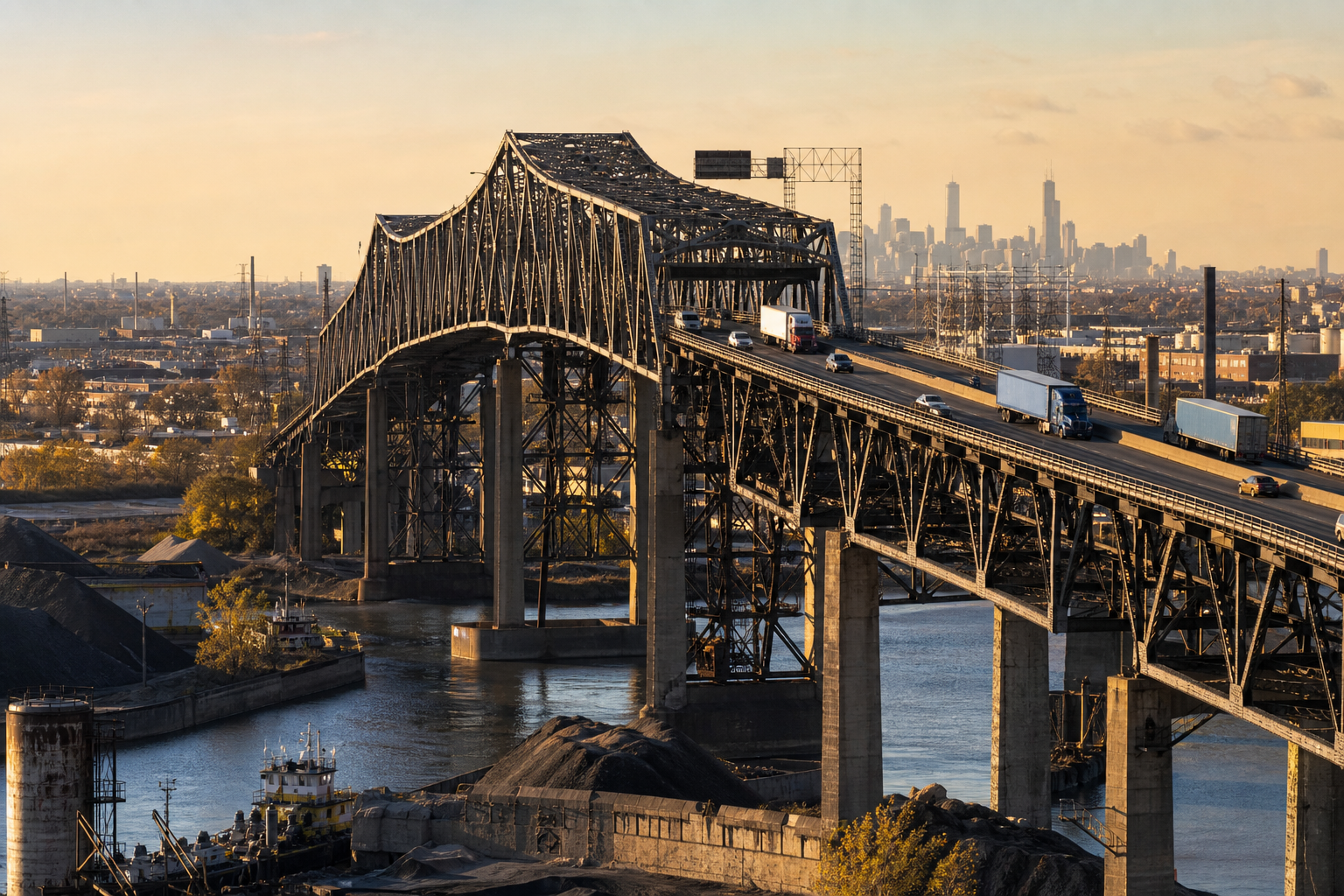

Chicago’s Skyway lease, read from the documents the city posts and the filings of the concessionaire’s owners: a 99-year concession the city’s financial statements date to January 2005, for a one-time payment of $1.83 billion — of which $446.3 million refunded the Skyway’s own bonds, by the city’s statements, and $975 million went into three reserve funds whose schedules the city posts. Two of those funds were drawn to $134,000 and $4,000 by mid-2016; the third, the $500 million long-term fund, stood at $521,287,000 then. Doing the deal cost $11,977,992 in fees, $8.4 million of it to Goldman Sachs. And the city still carries $1,441,818,000 of the payment as revenue not yet recognized at the end of 2025, counting $18.5 million a year through 2103. Control of the concessionaire has changed twice since — today, by the owners’ own filings, Atlas Arteria holds 66.67 percent of it and Ontario Teachers’ 33.33 percent, with a sale process paused as of June 29, 2026 — while the city’s posted record of who controls it stops at its 2016 approval. Every dollar figure here is quoted from a named public document, each linked; the arithmetic this page adds — balances, totals, percentages, term dates — is recomputed from those documents’ own lines and disclosed at the end.
City asset-lease documents + 2025 and 2024 financial statements + COFA + FHWA + the owners’ own releases, each read at retrieval · August 21, 2026The terms, from the primary documents
The city’s 2025 basic financial statements state the skeleton: “In January 2005, the City completed a PPP considered as a service concession arrangement of the Skyway,” granting a private company the right to operate the 7.8-mile toll road and collect its tolls “for the 99-year term of the agreement,” for an upfront payment of $1.83 billion. The city’s 2016 approval letter names the instrument — the Chicago Skyway Concession and Lease Agreement, dated as of October 27, 2004, with Skyway Concession Company LLC — and the Federal Highway Administration’s project profile dates the lease’s commencement to January 26, 2005. The concessionaire’s current majority owner puts the expiry at January 2104. Measured from that January 26, 2005 commencement to this page’s August 21, 2026 retrieval, 21 years and nearly seven months of the term have run, and about 77 years and five months remain to January 2104. The Council Office of Financial Analysis records the original concessionaire as a joint venture of Cintra and Macquarie Infrastructure Group, and calls the deal the first lease of an existing U.S. toll road to a private operator.
Where the $1.83 billion went
- Retire Skyway debt$463,000,000
- Pay down long-term city debt$134,000,000
- Eliminate short-term obligations$258,000,000
- Long-term reserve fund$500,000,000
- Mid-term reserve fund$375,000,000
- Neighborhood and human infrastructure fund$100,000,000
The FHWA’s value-capture case study itemizes six uses that sum exactly to $1.83 billion. The city’s own statements put one of them differently: “a portion of the payment ($446.3 million) advance refunded all of the outstanding Skyway bonds,” against the FHWA’s $463 million for retiring Skyway debt. The two documents are reported side by side and are not reconciled here. The three reserve funds are the city’s own creation, and the city posts a schedule for each: the ordinance’s Section 1, quoted on those schedules, directed a $500 million Long-Term Fund whose investment earnings “shall be transferred each year, commencing in 2005, to the Corporate Fund,” a Mid-Term Fund of the remaining proceeds — estimated at $375 million, with $50 million each for 2004 and 2005 — and a $100 million neighborhood/human infrastructure fund, $34 million of it for 2005 and $66 million after 2005 and before 2010.
The three funds, by the city’s own schedules
- Long-Term Reserve Fund(deposit $500,000,000)earned $234,282,000 / transferred $212,995,000$521,287,000
- Mid-Term Reserve Fund(deposit $375,000,000)earned $50,134,000 / transferred $425,000,000$134,000
- Neighborhood Human Infrastructure Fund(deposit $100,000,000)earned $12,274,000 / transferred $108,547,000 / disbursed $3,723,000$4,000
The city posts one schedule per fund — long-term, mid-term, neighborhood — each carried to June 30, 2016, and each balance above is recomputed from its own lines. The Long-Term Fund worked the way the ordinance’s clause reads: over the twelve years the transfers to the Corporate Fund took $212,995,000 of the $234,282,000 earned — 91 percent — tracking each year’s earnings closely in most years ($18.3 million earned and $18.2 million transferred in 2005; $12,003,000 and $12,000,000 in 2014) and exceeding them in only three, by at most $2.2 million in 2010, so the principal held and the balance grew to $521.3 million, with 2016’s transfer shown as zero and a $15 million transfer noted in the 2016 appropriation. The Mid-Term Fund was the opposite by design: $100 million out in 2005 (including the ordinance’s $50 million for 2004), $50 million to $75 million a year through 2011, and earnings that fell from $13.7 million in 2006 to zero in 2012 as the balance did; $134,000 remained. The neighborhood fund moved $108.5 million to the Corporate Fund and $3.7 million in direct disbursements against $100 million deposited and $12.3 million earned, leaving $4,000. The city’s 2025 statements describe the Long-term portion of its Service Concession and Reserve Fund as committed “for future budgetary and credit rating stabilization”; a later balance for the Skyway fund alone is not in the posted schedules, and this page does not estimate one.
What the deal cost to do
- Goldman Sachs(financial advisor)$8,400,000
- Mayer Brown(legal)$2,107,299
- Pugh Jones(legal)$462,482
- Loop Capital Markets(financial advisor)$300,000
- Cabrera Capital Markets(financial advisor)$300,000
- Gardner Rich(financial advisor)$252,080
- Katten Muchin(legal)$100,000
- Sanchez & Daniels(legal)$43,000
- Title, survey, audit and trust fees(three firms)$13,130
The city’s one-page expense summary totals $11,977,992: financial advisors $9,252,080 (77 percent), of which Goldman Sachs’s $8,400,000 is 70 percent of everything; legal services $2,712,782 (Mayer Brown’s $2,107,299 is 18 percent of the total); and $13,130 of title, survey, audit and trust fees. One note on the sheet’s own arithmetic: its four legal lines sum to $2,712,781, a dollar under its printed legal subtotal — a one-dollar discrepancy between the listed lines and the printed subtotal, reprinted as the document has it. Against the $1.83 billion received, the fees are 0.65 percent.
The city’s 99-year accounting clock
The city did not book $1.83 billion as 2005 revenue. Its statements record “a deferred inflow of $1.83 billion that will be amortized and recognized as revenue over the 99-year term of the agreement,” at $18.5 million a year “through 2103.” The Skyway Fund’s balance sheet shows the unrecognized remainder: $1,460,303,000 at December 31, 2024 and $1,441,818,000 at December 31, 2025 — a year’s difference of $18,485,000, which is $1.83 billion divided by 99 to the thousand. The same statements list the Skyway Fund among the city’s funds with deficits, at $1,249.3 million at the end of 2025, “which management anticipates will be funded through recognition of deferred inflows.” On the other side of the ledger, the Council office’s P3 report states that Skyway toll revenues reached $120 million in 2022, up from $114.3 million in 2021 — COFA’s figures, reported as such, from a different document than the city’s accounting and not combined with it here.
Who controls the concessionaire, by their own documents
The city’s posted record has one entry after 2005: on February 25, 2016, the city approved a change in control of the concessionaire, recording the owners’ December 1, 2015 letter that Calumet Concession Partners (AcquireCo) LLC — a consortium of Borealis Infrastructure, the Canada Pension Plan Investment Board, and the Ontario Teachers’ Pension Plan Board — had agreed to buy all of Skyway Concession Company LLC. The FHWA profile puts that sale at $2.8 billion with three equal $512 million equity contributions. The next change is recorded by the sellers themselves: on September 12, 2022, CPP Investments and OMERS Infrastructure announced the sale of their two 33.33 percent stakes to Atlas Arteria at “an equity value of US$2.013 billion for the 66.67% majority interest,” with Ontario Teachers’ retaining its third; Atlas Arteria’s 2022 results record the acquisition as completed on December 1, 2022. The newest entries are 2026’s, all Atlas Arteria’s own or its regulator’s: on April 22, 2026, Atlas issued Ontario Teachers’ a right-of-first-offer notice for its 66.67 percent while weighing a sale of the asset (ASX release, May 13, 2026; the Australian Takeovers Panel’s published reasons set out the shareholders’ agreement’s ROFO and a put option letting Ontario Teachers’ sell its stake to Atlas at fair value plus 7.5 percent on a change of control at Atlas); and on June 29, 2026 Atlas announced it would pay US$100 million “to extinguish the latter’s put option over its 33.33% stake” and “has paused its process to explore a potential sale of Chicago Skyway,” to decide next steps after a pending takeover offer for Atlas itself closes. Those are the owners’ statements as of their dates. The city’s asset-lease page posts the 2016 approval and no document on the 2022 transfer; what the city did or did not do about that transfer is outside its posted record and is not claimed here.
Known limits
This page reports what the documents record and takes no position on the deal’s wisdom; where a characterization appears, it is a named document’s own. The Council office’s P3 report says the lease “is often referenced as a point of caution” for future asset leases and, in the same passage, that at the time the deal was lauded by the credit-rating agencies — both reported here as COFA’s statements. Figures from different documents are never summed: the fund schedules are the city’s, carried to June 30, 2016; the deferred-inflow figures are the city’s 2024 and 2025 statements; the use-of-proceeds split is the FHWA’s; toll revenue is COFA’s; ownership and prices are the owners’ own releases and a federal profile. Toll rates, traffic, and the concessionaire’s finances are not reprinted. The 642-page concession ordinance posted by the city is a scanned image and was not text-searched; the clauses quoted from it are as the city’s fund schedules reprint them.
- City documents the Department of Finance’s Asset Lease Agreements page and its Skyway postings — the privatization expense summary, the three reserve-fund schedules (long-term, mid-term, neighborhood), the February 25, 2016 change-in-control approval, and the 2004 ordinance (scanned); the city’s 2025 and 2024 basic financial statements; and the Council Office of Financial Analysis P3 and Asset Leases Report.
- Other documents the Federal Highway Administration’s project profile and value-capture case study; the September 12, 2022 CPP Investments/OMERS release; Atlas Arteria’s 2022 results, May 13, 2026 ASX release, June 29, 2026 release and portfolio page; and the Australian Takeovers Panel’s reasons in Atlas Arteria 02 [2026] ATP 9. All retrieved August 21, 2026.
- Counting Fund balances, the cost total, and the use-of-proceeds sum are recomputed from each document’s own lines; the 99-year amortization is checked as $1.83 billion divided by 99 against the statements’ year-over-year change; term arithmetic runs from January 2005 to January 2104. Dollar figures are quoted without adjustment, and figures from different documents are never combined in any total.
Compiled by KCM Desk from the city’s posted documents and the named filings, retrieved August 21, 2026. Human-guided and edited — about this desk. If you spot an error, corrections come first.
Related Keep Chicagoland Moving coverage
- Chicago’s Pensions, as the Documents State Them: $14.2 Billion Held Against $50.6 Billion of Pension Liability at the End of 2025, 28 Percent Funded — and No Fund Projected to Pass 50 Percent Before 2043 on the Schedule State Law Sets
- How Chicago Works, by the Numbers
- Chicago’s Parking-Meter Deal, From the Documents: More Than $1.15 Billion Up Front in 2009, $161 Million in True-Up Payments Through 2024 — and a Sale the City Council Approved 46 to 3, on Conditions
- The Lowest Posted Clearance in Chicago’s Truck-Limit File Is 9 Feet 8 Inches — and One in Three Postings Sits Below 13 Feet 6