
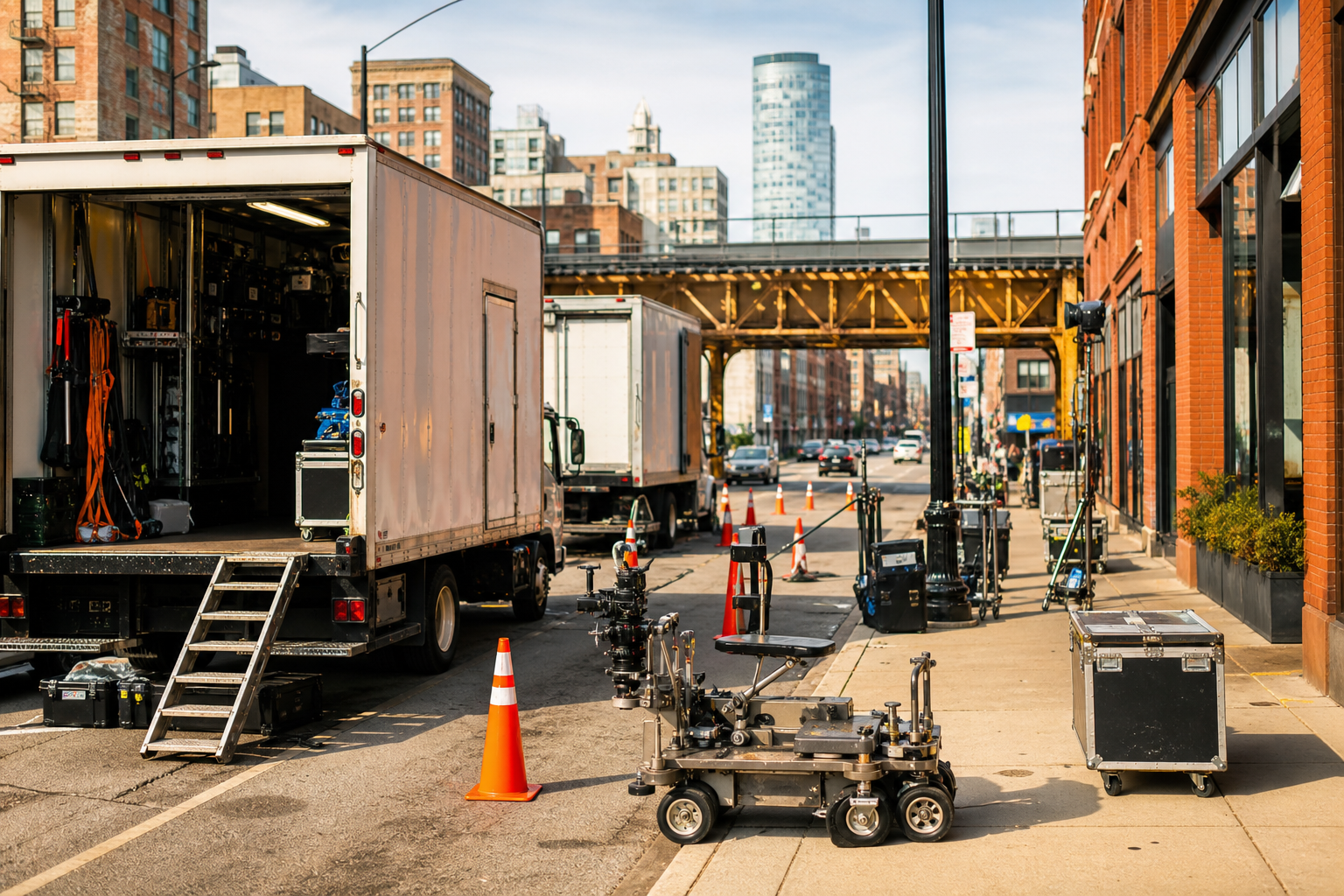

Since 2021, Chicago’s filming-permit file shows $8.78 million in calculated fees — and $5.66 million of it waived, about two-thirds. The file records no reason for any waiver, and this page offers none. When a production wants to block a Chicago street, it applies to the transportation department, and the city publishes the applications as data: 26,307 in the file since 2013, carried on 53,168 location rows. The volume is a story of its own — 1,600 to 2,725 applications a year before 2020, a floor of 949 that year, 2,084 in 2024, then 1,661 with 2025 start dates.
Filming Permits — Transportation Department, Chicago data portal · file refreshed August 11, 2026; retrieved August 13 · applications with start dates 2013 into 2026, counted at application grainReading a filming permit
The dataset holds CDOT permit applications whose work type is filming — permission to block or otherwise affect the public way, in the dataset’s own description. One reading rule carries this page: a row is a location on an application, not an application — 10,842 applications span more than one location row, up to 20 — and the fee figures repeat identically on every location row of an application, so summing the fee column across raw rows roughly quadruples the money. Everything here is counted once per application. An application is also not a production: one show can file dozens of applications across a season, and the file does not group them.
The volume, year by year
- 20131,908
- 2019the last pre-2020 year2,394
- 2020the floor949
- 20242,084
- 20251,661
- 2026 so farstart dates through the August refresh846
Application counts ran between 1,600 and 2,725 a year from 2013 through 2019, dropped to 949 in 2020, and have moved unevenly since: 2,123 in 2021, 1,368 in 2023, 2,084 in 2024, 1,661 in 2025. The file counts applications for street use, and nothing in it says why any year rose or fell. Of all 26,307 applications, 24,819 are marked closed and 1,488 open.
The fees, and the waivers
- 2018$0.11M$0.00M
- 2021$1.95M$1.17M
- 2024$1.81M$1.18M
- 2025$1.64M$1.13M
- 2026 so far$0.75M$0.48M
The fee columns changed character twice. Through 2018, calculated fees on filming applications were small — $110,000 or less a year — and yearly waivers never reached $29,000. Calculated fees stepped up in 2019, and from 2021 on, the waiver column runs at scale: $8.78 million calculated across applications with 2021–2026 start dates, $5.66 million waived — 64 percent. In every year since 2021, most of the calculated total was waived. The file’s columns are “total permit fees… calculated based on the work” and the amount waived; what policy produced any waiver, and who decided it, are not in the file.
Where the location rows point
- S. Blue Island203
- S. Wabash174
- W. 13th147
- W. Maxwell138
- N. Clark136
- W. 21st128
- W. 18th119
- S. Racine108
Counted at the location-row grain — the unit the file uses for where a permit applies — the streets that appear most on applications with 2024 or later start dates cluster tightly: South Blue Island Avenue (203 rows), South Wabash (174), West 13th Street (147), West Maxwell (138), North Clark (136), West 21st (128), West 18th (119), and South Racine (108). Most of those run through the Near West Side and Pilsen’s edges. The rows say where street use was requested; they do not say what was filmed there.
Known limits
Applications are counted by their start date, and 2026 is in progress. A calculated fee is the file’s own figure for the work described; the difference between calculated and waived is not necessarily what was collected, and the file does not carry a collected-amount column. About a thousand location rows carry no coordinates, which does not affect the application-grain counts. Applicant names and contact fields exist in the file and are not used here. Nothing in the dataset identifies productions, titles, or studios, and this page draws no such link.
- Sources Filming Permits — Transportation Department (c2az-nhru, 53,168 location rows, 26,307 distinct applications, file refreshed August 11, 2026), retrieved August 13, 2026.
- The grain Fee figures repeat identically across every location row of an application — verified on all applications with more than one row — so volumes, fees, and waivers are counted once per application number. Street counts use location rows and are labeled as such.
- Counting Years are application start years. Fee and waiver sums use the file’s totalfees and waivedfees columns as published; the 2021–2026 share divides summed waivers by summed calculated fees for start dates in that range.
Computed by KCM Desk from records retrieved August 13, 2026. Human-guided and edited — about this desk. If you spot an error, corrections come first.
Related Keep Chicagoland Moving coverage
- The Park District’s Event File Is Three Calendars in One: 96,765 Permit Rows, 40,553 Administrative Reservations, 5,048 Venue Rentals — and 13 Rows Marked Denied Since 2012
- How Chicago Works, by the Numbers
- Chicago’s Transportation-Permit File Holds 1.8 Million Applications. More Than Half Are Marked Open.
- The Lowest Posted Clearance in Chicago’s Truck-Limit File Is 9 Feet 8 Inches — and One in Three Postings Sits Below 13 Feet 6
- In 90 Days, Chicago Recorded 5,396 Vehicle Tows — and 4,259 Relocations
- Chicago’s Sidewalk Cafés Are Nearly Back to Their 2019 Count. The Loop Is at 75 Percent.