

This page includes links to products on Amazon. As an Amazon Associate I earn from qualifying purchases.
The Second
Fight
In October 1871 the Great Chicago Fire burned about three square miles of the city in some thirty hours, took an estimated 300 lives, and left roughly 100,000 people — three in ten Chicagoans — without homes.
That was the disaster, and we map it hour by hour in a companion page. This page is about what came after: the fight over who could afford to rebuild. It ran three more years — through a mass march on the Common Council, a relief operation that sorted the burned-out by class, and a second fire — and its outcome settled where each class of Chicagoans could afford to rebuild.

The Rebuilding Ledger
The recovery, in six numbers
The Fireproof Ticket
A mayor elected to outlaw wood
A month after the fire, Chicago elected Joseph Medill — publisher of the Tribune — as mayor on the Union-Fireproof ticket, and in his inaugural address he vowed action that would make another such catastrophe impossible. The instrument at hand was an old one: the fire limit, a boundary inside which every new building had to be brick or stone. Chicago had drawn its first around the business center in 1845. The Fireproof proposal was to draw it around the entire city.
The Encyclopedia of Chicago’s fire-limits entry describes what such limits really were: primitive zoning codes, dressed in the language of fire prevention. Inside the line, new wood construction was banned, and so were major repairs to the wood buildings already standing. Masonry was commercial-grade construction at commercial prices. To a laborer whose entire stake in the city was a wooden cottage, a citywide limit read as a ban on ever owning a new house.
Mid-January, 1872
The march on the Common Council
The council took up the citywide ban with the ruins still being cleared. In mid-January of 1872, an angry crowd of demonstrators pushed into a Common Council meeting to oppose it, carrying painted boards whose texts survive.
Don’t vote any more for the poor man’s oppressor
Placard carried into the Common Council, January 1872
The marchers’ grievance, as the Chicago History Museum’s fire history puts it, was that restrictions on flammable building materials discriminated against those who could only afford wood. The crowd drew heavily on the German working-class wards of the North and West Divisions — homeowners whose equity was a wood cottage and whose only route to another one was cheap lumber. Their aldermen heard them. The citywide ban failed.
What passed instead, on February 12, 1872, banned wood construction only in the immediate business district. One architectural historian’s verdict on that revised code: it “amounted to nothing more than a whitewash.” The city that had just burned went on to rebuild most of itself in the material that had burned.
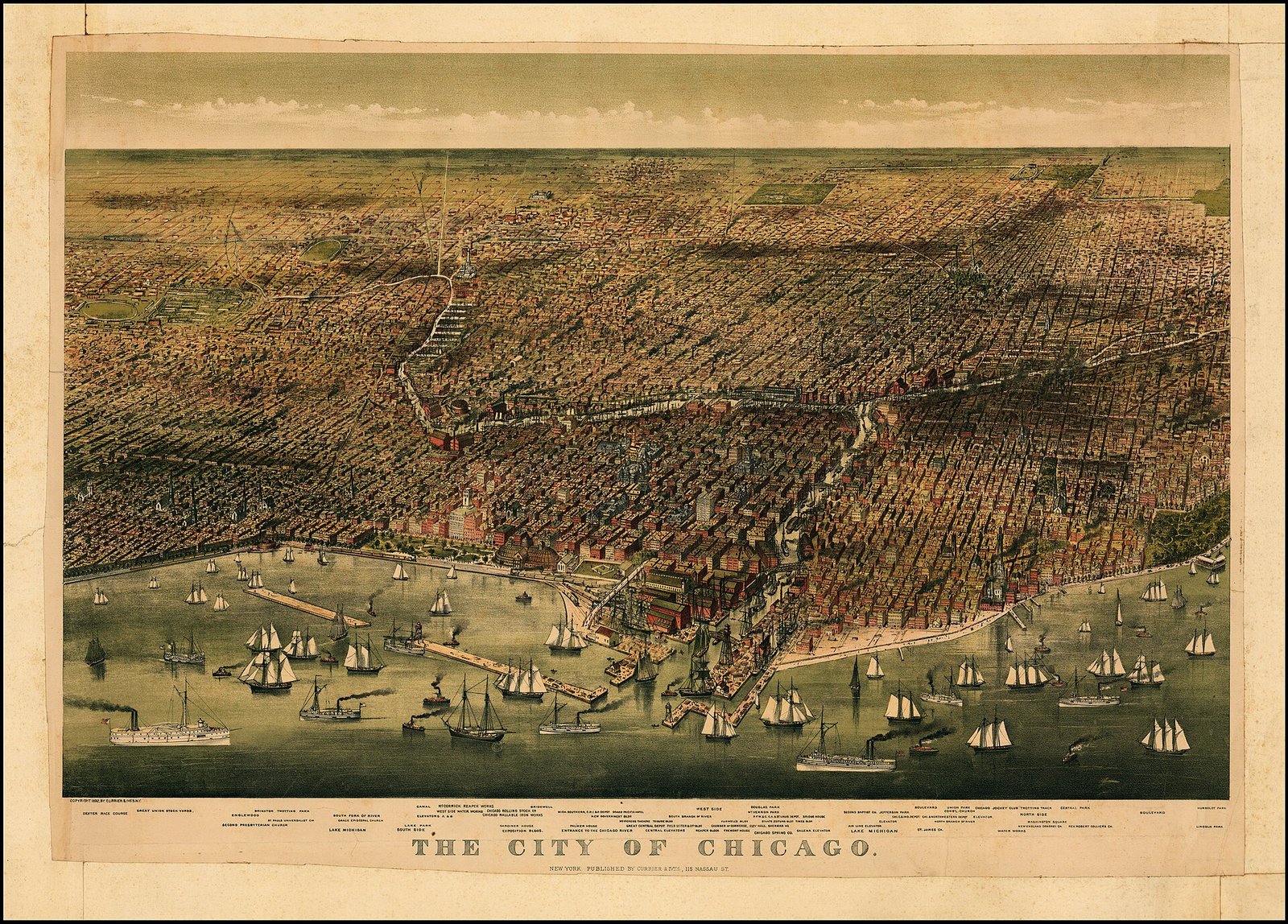
.jpg?width=1600)
The Relief Ledger
Aid, sorted by class
While the council argued about wood, a private board decided who got help. On October 13, 1871, Mayor Roswell Mason handed the entire relief operation to the Chicago Relief and Aid Society, a businessmen’s charity whose directors included the merchant Marshall Field, the sleeping-car manufacturer George Pullman, and the attorney Wirt Dexter. About five million dollars in aid from around the world flowed through its districts and depots. Its ledgers sorted the city into tiers.
A Committee on Special Relief quietly aided fire victims “of refinement,” sparing them the public queue.
Shelter cottages — small ready-built houses of twelve by sixteen or twenty by sixteen feet — went mainly to tradesmen such as carpenters, the men the rebuilding needed.
Roughly a thousand families of the poorest burned-out Chicagoans were housed in four barrack compounds, two furnished rooms per family.
In February 1872 the Society dropped about eight hundred families from its rolls as the county’s responsibility — midwinter, and over public protest.
Aid came with conditions. Applicants needed a reference from an employer or a minister and a home visit from a Society “visitor,” under a stated policy of detecting and defeating “imposition,” and no aid went to families judged capable of earning their own support. The board’s own framing of its mission was the reestablishment of the social and economic order the fire had disrupted.
The Sorting
Who built where after the compromise
The 1872 compromise drew a line through the city, and the market did the rest. Downtown, land carried commercial prices and the business district roughly doubled in size as it rebuilt — taller, in masonry, and more strictly sorted by trade than before the fire. A new home inside the limits meant brick money.
Workers who needed wood built where wood stayed legal: in the outer wards beyond the line, and increasingly past the city limits altogether. A real-estate booster of the period reported “a brisk demand for building just outside the city limits.” The well-off moved the other way — south to Prairie Avenue, or out to planned suburbs like Riverside.
Then, in July 1874, a second fire took about fifty acres and more than eight hundred buildings. Afterward the Common Council did what it had declined to do in 1872 and drew the fire limits around the entire city. From 1874 on, a new wooden house was in practice something built outside Chicago — in the cottage settlements and towns the city would later annex. The pattern outlived the argument: a masonry core, a wooden periphery, and a housing ladder whose bottom rungs stood on the periphery.
A private society takes over relief
Mayor Roswell Mason transfers the relief operation to the Chicago Relief and Aid Society, five days after the fire.
Medill and the Fireproof ticket
Joseph Medill is elected mayor a month after the fire, vowing to make another such catastrophe impossible.
Demonstrators fill the council chamber
A crowd from the German wards disrupts the Common Council, placards raised against the citywide wood ban.
Wood banned downtown only
The revised building code confines the wood ban to the immediate business district — a “whitewash,” in one architectural historian’s judgment.
Two strikes, two outcomes
Carpenters strike and lose; bricklayers, the rebuilding’s indispensable trade, strike and win.
Hesing convenes the People’s Party
The immigrant coalition takes political form; that fall its candidate, Harvey Colvin, wins the mayoralty by a plurality of about ten thousand.
Fifty acres, eight hundred buildings
Another major fire strikes the city. This time the Common Council extends the fire limits over all of Chicago.
The Backlash
Hesing turns the anger into a party
The fight had a second act at the ballot box, and its central figure was Anton Hesing: a brewer’s son from Vechta who had come over in 1839, served as Cook County sheriff on the same 1860 ticket as Abraham Lincoln — the first German immigrant elected to office in Illinois — and since 1867 held sole control of the Illinois Staats-Zeitung, the loudest German newspaper in the city.
His readers had been targeted twice under the Medill administration: a proposed wood ban aimed at their houses, then enforcement of long-ignored Sunday-closing laws aimed at their taverns and beer gardens. On May 14, 1873, Hesing convened the convention that founded the People’s Party. That autumn its candidate took City Hall. Whether Hesing stood in the council chamber in January 1872, the record we can verify does not say. What is documented is what he built from the same anger.
What It Left
Chicago still shows the split: brick center, wooden neighborhoods
The fire-limit fights were zoning fights before the word existed; the Encyclopedia of Chicago calls them a precursor to the zoning debates of the 1920s. Their outcome is still visible in the city’s building stock. Where the limits reached, new houses had to be masonry, so central Chicago filled in with brick and stone. Where they did not reach — the outer wards, and the towns the city later annexed — people kept building in wood, and those areas filled with workers’ cottages and wooden flats. That split began as the compromise of 1872 and hardened when the limits went citywide in 1874.
“Leave a Home for the Laborer.”Placard carried into the Common Council, January 1872
Sources & method. The rebuilding narrative — the mid-January 1872 demonstration and its placard texts, the pace of reconstruction, the fall 1872 strikes, and the July 1874 fire — follows the Chicago History Museum’s Great Chicago Fire & the Web of Memory project; the Relief and Aid Society’s board, policies, tiers of aid, and the February 1872 cutoff follow the same project’s Rescue and Relief essay. The fire-limits framing, the 1845 first limit, the 1872 defeat and the 1874 citywide extension are from the Encyclopedia of Chicago’s Fire Limits entry by historian Robin Einhorn. The February 12, 1872 code and the “whitewash” judgment are from The Architecture Professor. Medill’s vow, the downtown-only compromise, the “brisk demand” quotation and the movement to Prairie Avenue and Riverside are from WBEZ’s Curious City with historian Carl Smith. Hesing’s biography and the People’s Party dates follow his standard biographical entry. Some things this piece deliberately does not claim, because our sources do not establish them: who led the January 1872 march, whether Hesing was present at it, and the precise cost gap between brick and wood construction. The deeper histories are Karen Sawislak’s Smoldering City and Christine Meisner Rosen’s The Limits of Power, both cited by the Encyclopedia entry above.
ON AMAZON
Books on the Great Chicago Fire
- Chicago's Great Fire: The Destruction and Resurrection of an Iconic American City, by Carl Smith. A history of the fire and the rebuilding.
- The Great Chicago Fire (Images of America), by John Boda. A photographic history in the Images of America series.
- The Great Fire, by Jim Murphy. A nonfiction account written for younger readers.
As an Amazon Associate I earn from qualifying purchases.
Reported by KCM Desk from the Chicago History Museum’s fire history project, the Encyclopedia of Chicago, and the sources linked above; published July 24, 2026. Human-guided and edited — about this desk. If you spot an error, corrections come first.
Related Keep Chicagoland Moving coverage
- The Great Chicago Fire of 1871: Map, Timeline, and What It Left Behind
- Chicago’s Tax Rolls Show 7,875 Fewer Two-to-Six-Flats Than in 2006. Of the 13,049 Parcels That Left the Count, 6,208 Are Now Classed as Single-Family Houses.
- The New Federal Housing Law: Four Provisions That Reach Chicago, Measured Against Our Records