Chicago on the Clock: We Timed 793,774 Service Requests, Neighborhood by Neighborhood
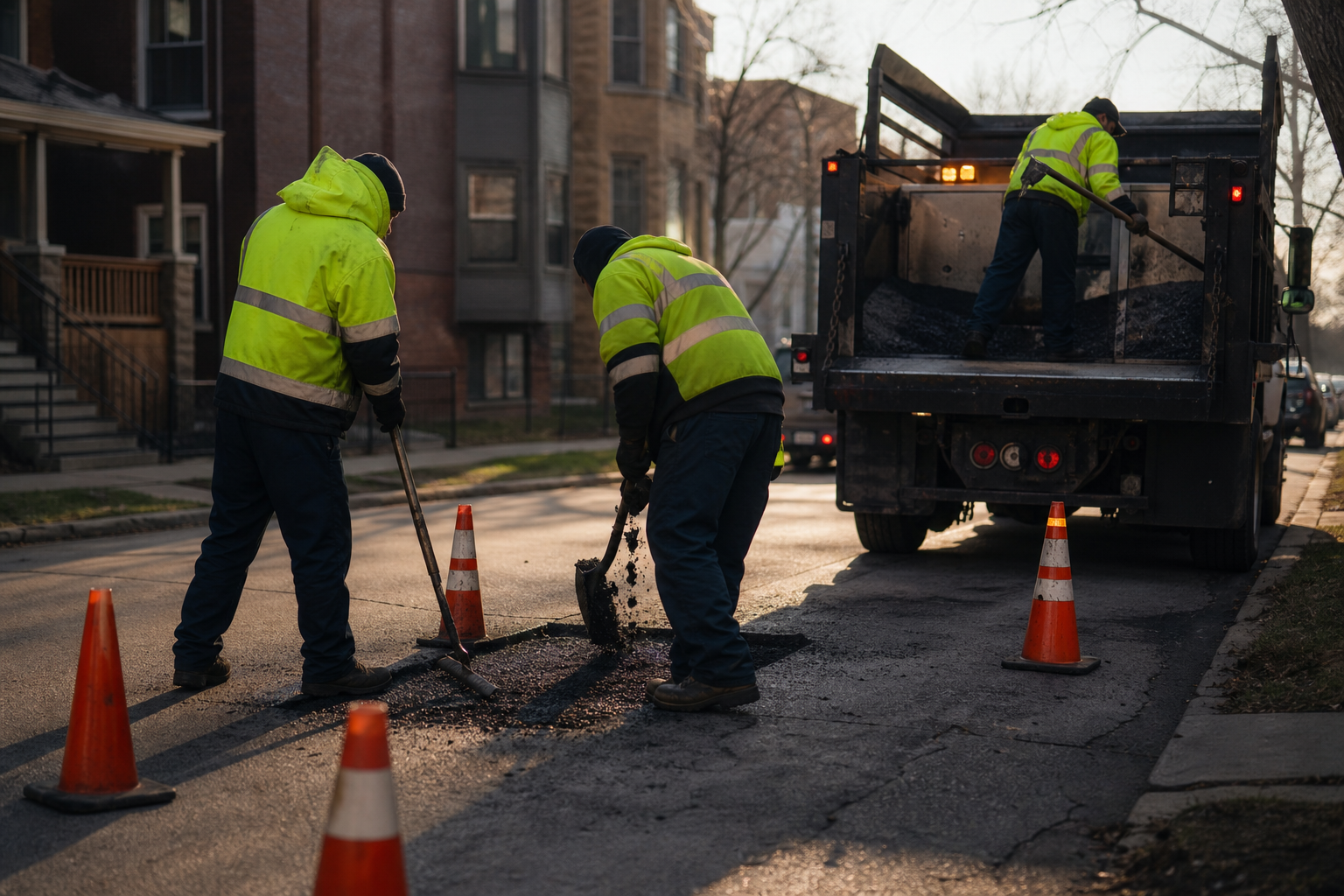
Traffic signals get fixed in three hours; a garbage cart takes fifteen days; and the pothole map has a geography all its own. We put a stopwatch on two and a half years of Chicago's 311 files, for all eight everyday services, in all 77 community areas.
Call 311 about a pothole and the city opens a file. What happens next is a timestamp: when the request was created, and when a crew closed it. We pulled 793,774 of those files, every non-duplicate request for eight everyday services filed from January 2024 through March 2026, late enough cutoff that every request had months of runway to close, and put a stopwatch on each one. The result is a scoreboard nobody assembles from those public timestamps: how fast the city closes its own files, service by service and neighborhood by neighborhood.
793,774
service requests timed, 2024 to mid-2026
3 hrs
median close for a traffic signal out, the fastest clock
14.9 days
median wait for a garbage cart, the slowest
89 days
what the unluckiest tenth of pothole requests wait
The city has reflexes and it has queues
The scoreboard splits cleanly in two. When safety is on the line, Chicago moves like it means it: the median dead traffic signal is closed out in about three hours, and the median graffiti request in under a day, a pace the Graffiti Blasters program has been famous for since the nineties. Streetlights and rat baiting follow within a few days. Then come the queues, which are all about objects rather than hazards: the median abandoned-vehicle report waits close to twelve days, and the humble garbage cart, cracked or stolen or melted, waits 14.9 days, the longest line in our set.
One honest caution before the maps: a closed record means the city marked the work done, which is not always the same as the problem being solved to your satisfaction. And the handful of medians that read “same day” partly reflect crews that patch first and close the paperwork after. To keep the clock honest, our statistics only cover requests old enough to have had months to close, and the small number still open count at their age so far, so slow cases are not quietly dropped. The clock we can measure is the city’s own clock. It is still a revealing one.
Eight services, eight different maps
Here is the finding we did not expect: there is no single “slow side of town.” Each service has its own geography. Abandoned vehicles sit longest in Lincoln Park and Lake View, nearly three weeks at the median, roughly triple the wait in Bridgeport and nearly seven times the Loop’s; denser curb parking and slower tow logistics are plausible reasons, though the records do not say. Garbage carts crawl in Rogers Park, the Loop, and the Near West Side, all past twenty days. And on the service where the task is most identical everywhere, a dark streetlight, the city is strikingly even: all 77 community areas fall inside a band from 1.7 to 4.3 days, and the slower end of that band includes O’Hare and the Near North Side.
Potholes are the exception, the one service with a real geographic gradient. A belt across the West and Northwest Sides waits longest: Hermosa’s median pothole request takes 17 days, North Lawndale’s nearly as long, Humboldt Park’s close to 13, against a citywide median of 5.1 and same-week service downtown. Our records show the wait, not the reason; resurfacing schedules, arterial priorities, and how many requests pile up per mile of street all plausibly feed it. Whatever the cause, a pothole file in Hermosa stays open more than three times longer than the city’s typical pace.
The pothole lottery
Medians describe the typical request. The tail describes your luck. Half of pothole requests close within 5.1 days, but the unluckiest tenth wait about three months, the widest spread in days of any service we timed. Abandoned vehicles show the same shape, twelve days typical but a tenth of cases stretching toward seven weeks. When a neighbor tells you 311 fixed their street in three days and yours has been open for two months, you are both telling the truth; you are just standing on different ends of the distribution.
The queue Chicago abolished on purpose
One request type is missing from our scoreboard by design. The city no longer accepts individual tree-trim requests at all. After years of complaint-driven trimming produced year-plus backlogs, the Bureau of Forestry switched in 2023 to trimming every tree in a 16-block grid on a schedule, a change that Illinois Answers found sharply increased the number of trees trimmed even as some residents grumbled about losing the ability to summon a crew. It is an unusually frank acknowledgment that a first-come-first-served queue was the wrong tool, and it makes the queues that remain, the carts and the vehicles and the potholes, look less like laws of nature and more like choices.
Look up your neighborhood
How we timed the city
Source: City of Chicago 311 Service Requests (v6vf-nfxy), pulled July 18, 2026: every non-duplicate request of the eight types shown, created January 1, 2024 through March 31, 2026, with the dataset’s own community-area field.
The clock: days from a request’s creation to its closure in the city’s system. Closure is the city’s definition of done. To avoid survivorship bias, statistics cover requests created at least 3.5 months before our pull, and requests still open enter at their age so far, a conservative floor; open cases are roughly 2 percent or less of each type. Rodent-baiting requests in this window were universally closed, which likely reflects administrative closing practice.
Neighborhood figures: medians per community area, suppressed under 30 closed requests. Very small medians (under a day) usually mean same-day closure, including work logged after it was already done.
What this is not: a measure of outcome quality, of every 311 type (we chose eight physical, field-crew services where the task is comparable across neighborhoods), or of why any given area runs fast or slow.
Computed by KCM Desk from records current to July 18, 2026; published July 18, 2026. Human-guided and edited — about this desk. If you spot an error, corrections come first.