
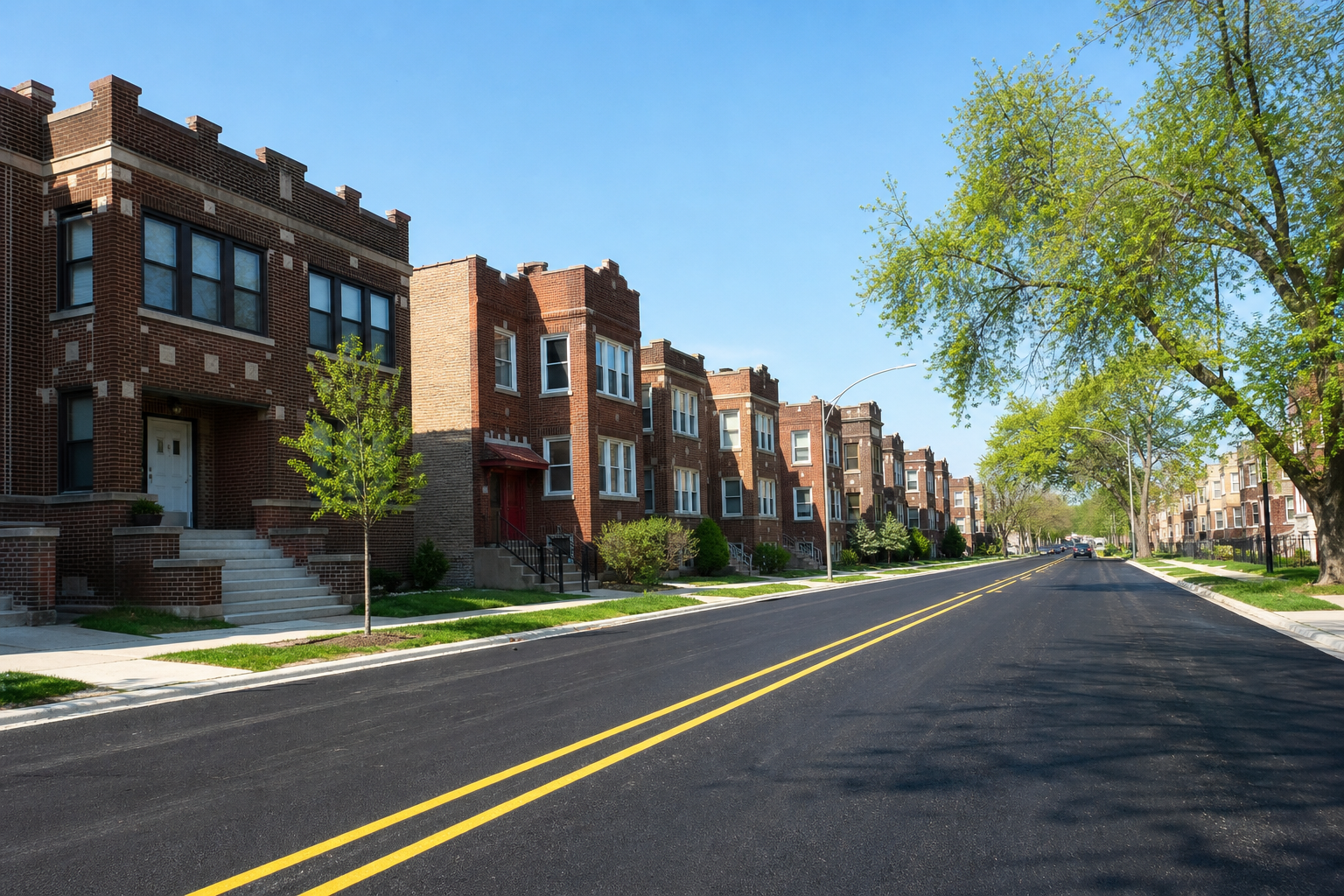

Chicago keeps a protection list for its streets — mostly for freshly repaved and rebuilt roadway, with smaller lanes for medians, traffic restrictions and a few blunter labels. The Department of Transportation’s moratorium file — one row per protected street segment, an address range on a named street — holds 36,508 rows dating to November 1998, and 14,093 of them are active today, counting every row whose expiration date is August 28, 2026 or later. The rules have teeth, in the portal’s own words: after a reconstruction, “By City ordinance, the moratorium is ten (10) years and during this period permit fees are doubled,” and after a repaving, “the moratorium is five (5) years and during this period permit fees are doubled.” “A degradation fee may also be applied,” the description adds. The file also holds its oddities, printed here as filed: one resurfacing moratorium on Churchill Street runs to May 12, 2207; a median moratorium on Madison Street carries no expiration date at all; and in a register of 36,508 rows, exactly three carry the bluntest label in it — “No Digging” — and exactly one of those is still active.
Roadway Construction Moratoriums (ndbz-vy4e), 36,508 street-segment rows, start dates November 30, 1998 – August 27, 2026 · retrieved August 28, 2026 · a row is an address range on a named street; the file has no length column and nothing on this page is stated in miles · “active” = expiration date on or after August 28, 2026Seven labels, one purpose
| Moratorium type, as printed | All rows | Active rows |
|---|---|---|
| Street Resurfacing | 34,630 | 13,691 |
| Median Landscaped | 901 | 209 |
| Traffic Restriction | 485 | 44 |
| Street Construction | 452 | 146 |
| Planned Street Resurfacing | 30 | 2 |
| Location Hold | 7 | 0 |
| No Digging | 3 | 1 |
Street Resurfacing does almost all the work: 34,630 of the rows ever, 13,691 of the active ones. The protections exist, per the description, for “protecting reconstructed or repaved roadways within the boundaries of the city” — so a freshly paved street costs more to cut open, by ordinance, for years. The description states the list’s purpose in its own words: “By having access to this Moratorium list in advance, contractors or utilities with projects that require excavation of roadways can more effectively plan and review conflicts.”
The active list: 14,093 segments on 993 streets
Today’s protections cover segments on 993 distinct street names. The street with the most active protected segments is 48th (105), followed by Washtenaw (98), Campbell (92), Wabansia (90) and 53rd (90) — counts of segments, not lengths. As retrieved August 28, 2026, the newest rows started August 27, including a Lockwood Avenue segment protected to August 2031. Whether a particular block is covered is checkable in the file itself, linked below, and on CDOT’s moratorium page.
How long the protection runs — and the rows that run to 2207
Among active rows, the ordinance’s clocks dominate: 8,963 active segments run five calendar years start-to-expiration and 1,245 run ten, matching the resurfacing and reconstruction rules the description quotes. Then comes the tail the file prints and this page does not repair: 218 rows carry expirations in 2040 or later, two reach past the year 2100, and the farthest-out expiration in the whole register belongs to a Churchill Street resurfacing moratorium that started in April 2023 and expires May 12, 2207 — a 184-year protection, as filed. A 35th Street median row runs to December 31, 2200. Whether those are typos or intent, the file does not say; they are what the register holds.
Protections logged per year
| Year | Segments protected (start dates) |
|---|---|
| 2019 | 2,402 |
| 2020 | 2,971 |
| 2021 | 3,217 |
| 2022 | 2,264 |
| 2023 | 4,906 |
| 2024 | 2,725 |
| 2025 | 2,453 |
| 2026 | 1,425 |
The counts are of moratorium rows by their start dates, nothing more — the file records protections, not paving projects, and its types include planned work and holds — so this page draws no paving-program conclusion from the table. What the table does say is plain: the file logged more protections in 2023 than in any other start year in the file.
- Source: CDOT’s Roadway Construction Moratoriums file (ndbz-vy4e): 36,508 rows, one per protected street segment, retrieved August 28, 2026. All figures computed on the city’s portal; the ordinance-mechanics quotes are the portal description’s own words, and CDOT’s moratorium page carries more.
- Grain: a row is an address range on a named street. The file has no length column, so this page counts segments and never states mileage. Street names are counted as printed.
- Active: a row is counted active if its expiration date is August 28, 2026 or later; 22,414 rows are expired and one row carries no expiration date. Duration figures are calendar-year differences between start and expiration years.
- Oddities: the 2207 and 2200 expirations and the no-expiration row are printed as filed; whether they are entry errors is not something the file states, and this page does not repair records.
Computed by KCM Desk from CDOT’s moratorium file, retrieved August 28, 2026. Human-guided and edited — about this desk. If you spot an error, corrections come first.
Related Keep Chicagoland Moving coverage
- Before a Shovel Touches Chicago Ground, the Notices Fly: 18,091,229 Utility Notifications Since 2018 — and the City Is the Second-Most-Notified Name on Its Own 811 List
- Chicago Has 1,937 Legislated Parking Zones. The Median One Is Two Block-Sides Long — and 1,382 Segments Hold Zone Rights With No Signs for Their Zone
- How Chicago Works, by the Numbers
- Chicago’s Patch Ledger Records 2.76 Million Potholes Filled Since 2018 — and 2026 Has Already Out-Filled All of 2025
- Chicago’s 811 File Holds 14,508 Utility-Hit Reports Since 2015. Gas Leads — and 846 Reports Record What Was Hit as UNKNOWN.
- Chicago’s Transportation-Permit File Holds 1.8 Million Applications. More Than Half Are Marked Open.