
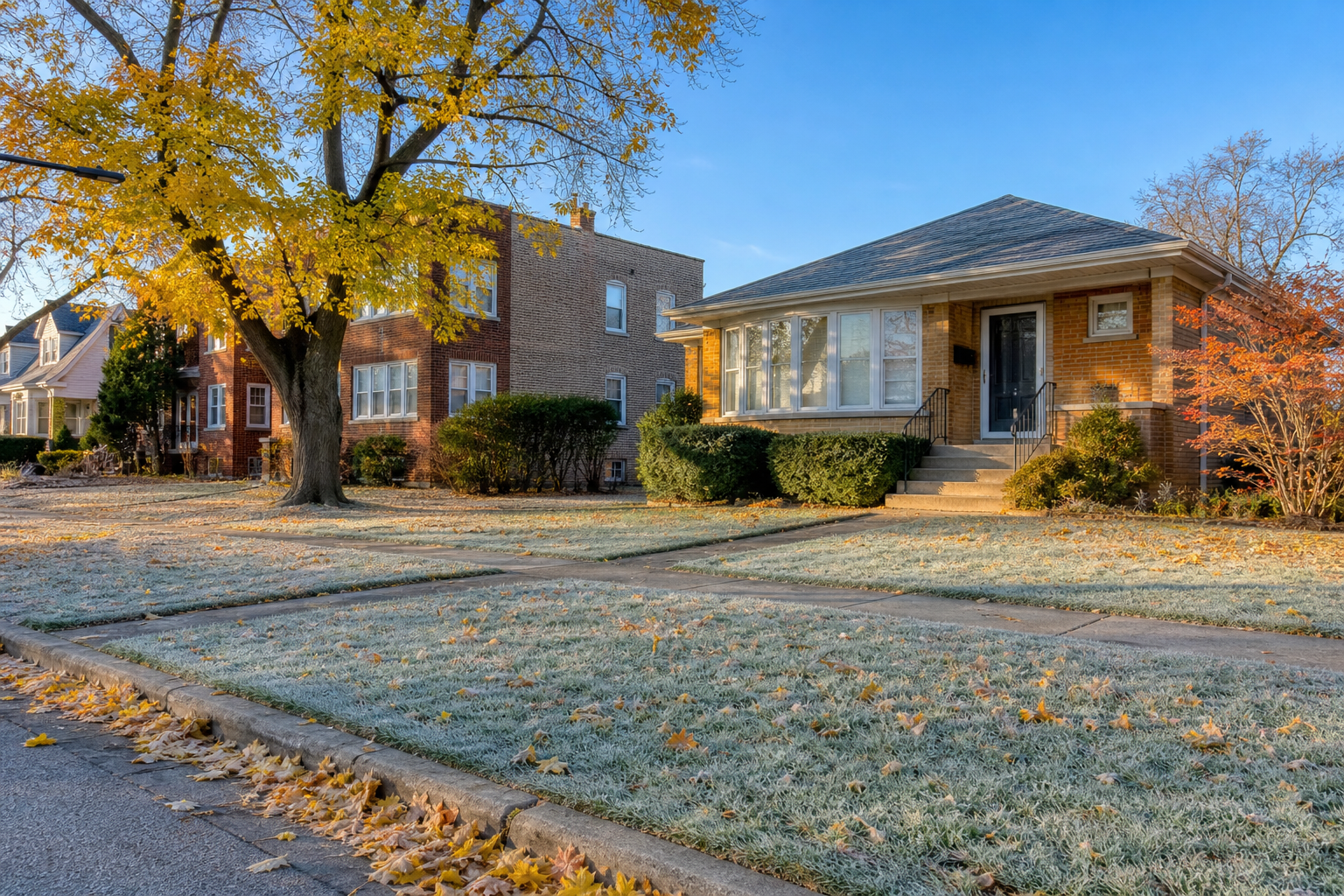

At O’Hare, the first fall freeze, the first night at 32 degrees or colder, came on a median October 28 from 1996 through 2025, sixteen days later than the October 12 median of 1966 through 1995. The last spring freeze moved a week earlier, to April 20, and the frost-free season between them grew from a median 168 days to 185. In 1996 through 2025 the first freeze had come by October 14 in 10 of 30 years and by November 11 in 28. This fall O’Hare’s lowest reading through October 8 was 48 degrees, on October 3; last year’s first freeze came November 9, and 2024’s, November 20, was the latest in the station’s complete years back to 1959.
NOAA’s daily station records (GHCN-Daily) for O’Hare and Midway, read October 9, 2026, through October 8 · a freeze is a low of 32°F or colder, a hard freeze 28°F · the medians, odds and decade figures are oursWhen does the first freeze come?
Most often in the last days of October or the first days of November. Across 1996 through 2025, O’Hare had its first freeze by October 14 in 10 of the 30 years, by October 28 in 16, by November 4 in 22 and by November 11 in 28. A hard freeze, 28 degrees or colder, comes later: by November 11 in 21 of the 30 years. The earliest first freeze in O’Hare’s record came September 22, 1974; the latest, November 20, 2024.
| By this date | O’Hare: first freeze had come | Midway: first freeze had come | O’Hare: first hard freeze had come |
|---|---|---|---|
| October 7 | 13% | 10% | 0% |
| October 14 | 33% | 17% | 3% |
| October 21 | 37% | 24% | 7% |
| October 28 | 53% | 45% | 17% |
| November 4 | 73% | 59% | 33% |
| November 11 | 93% | 86% | 70% |
| November 18 | 97% | 93% | 87% |
When is the last spring freeze?
Usually in April. In 1996 through 2025, O’Hare had a freeze on or after April 15 in 22 of the 30 years, on or after April 29 in 5, and on or after May 13 in 1. This year’s last freeze came May 2 at both airports; in the 30 years before, O’Hare’s came that late or later 3 times. The latest in its record was May 29, 1965.
| On or after this date | O’Hare: a freeze still came | Midway: a freeze still came |
|---|---|---|
| April 1 | 97% | 82% |
| April 8 | 90% | 68% |
| April 15 | 73% | 36% |
| April 22 | 43% | 11% |
| April 29 | 17% | 7% |
| May 6 | 7% | 7% |
| May 13 | 3% | 0% |
Has the frost-free season grown?
At O’Hare, yes: the median season ran 154.5 days in the 1960s and 196.5 in the 2010s, and 200 in the six years 2020 through 2025. The longest season in the record was 227 days, in 2017 and 2024. Comparing the two 30-year spans, the fall end moved more than the spring end: the first freeze sixteen days later, the last freeze seven days earlier. Our reading: at O’Hare, the 1996–2025 frost-free season reaches through late October, which in 1966–1995 was more often past the first freeze than not, and most of the added days are in the fall.
When does the first snow fall?
Usually in the second half of November. O’Hare’s first measurable snow, a tenth of an inch or more, came on a median November 18 in the snow seasons of 1996 through 2025, and its first day with an inch or more on December 4. The first snow had come by November 15 in 36 percent of those seasons, by November 30 in 68 percent and by December 15 in 93 percent. The snow calendar moved less than the freeze calendar: the 1966–1995 medians were November 13 and December 1. Last season’s first snow came November 9, the day of its first freeze.
| By this date | First measurable snow had come | First inch had come |
|---|---|---|
| October 31 | 14% | 4% |
| November 15 | 36% | 18% |
| November 30 | 68% | 39% |
| December 15 | 93% | 71% |
| December 31 | 100% | 86% |
Is Midway’s season longer?
By about a week and a half. In the 28 years both airports have complete records, Midway’s frost-free season ran a median 10 days longer than O’Hare’s, almost all of it in spring: its last freeze came a median 9 days earlier, while its first fall freeze came a median 1 day later. Midway sits on the Southwest Side among blocks of houses; O’Hare is at the city’s far northwest edge.
What can’t the record tell you?
What happens in a given yard: a low spot, an open field or a block near the lake can run colder or warmer than an airport sensor. Nor is it a forecast for this fall; the National Weather Service issues those. Over six decades the land around a station and its instruments change, and the record cannot separate those changes from the climate’s.
Where does the record live?
Every daily reading here is in NOAA’s Climate Data Online; O’Hare’s station is GHCND:USW00094846. Freeze warnings and forecasts come from the National Weather Service in Chicago.
- Records NOAA’s Global Historical Climatology Network daily summaries, read through the NCEI Access Data Service on October 9, 2026: O’Hare (USW00094846) from 1958, with snowfall, and Midway (USW00014819) from 1997, temperatures only.
- Definitions a freeze is a daily low of 32°F or colder; a hard freeze 28°F. A year’s last spring freeze is its last freeze before July 1 and its first fall freeze the first on or after July 1; the frost-free season is the days between. A snow season runs July 1 to June 30; first snow is the first day with 0.1 inch or more.
- Completeness a half-year counts only when 95 percent of its days carry a low; a snow season only when 95 percent carry a snowfall value. The 30-year spans are 1966–1995 and 1996–2025; the odds tables use 1996–2025.
Computed by KCM Desk from NOAA’s station records, read October 9, 2026. Human-guided and edited — about this desk. If you spot an error, corrections come first.
Related Keep Chicagoland Moving coverage
- How Chicago Works, by the Numbers
- Is Lake Michigan Warmer Than the Air? Chicago’s Paired Beach Sensors Recorded the Water Warmer on About One Matched Hour in Three
- Chicago Cited 1,605 Buildings for Inadequate Heat Over the Last Five Winters. South Shore Had 169, a Rate More Than Five Times the City’s
- Cook County’s Medical Examiner Has Flagged 14 Heat-Related Deaths in 2026, the Most of Any Year in Its Archive — Eight of Them Dated July 1 to 4
- Flu First Reached 10 Percent of Chicago Lab Tests in December in Eight of 16 Seasons, and as Early as Nov. 12. Last Season 69 Percent of the Children Who Got a Recorded Shot Had It Two Weeks Before Flu Reached That Mark.
- Chicago Houses That Closed in June Sold for 12 Percent More Than January’s in the Same Area, 2018 to 2024. Condominium Closings Ran Twice as High in May