
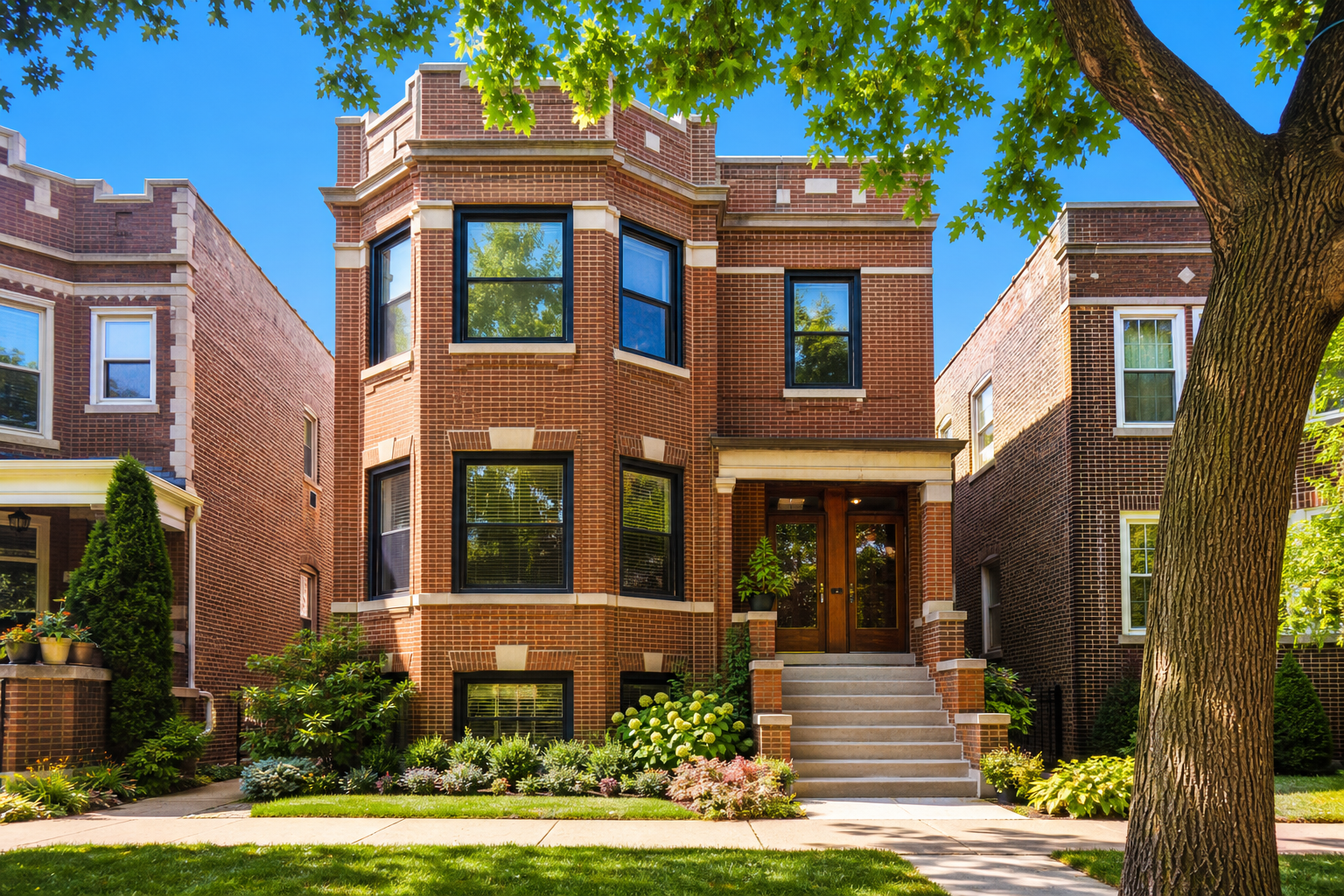

If you own property in Cook County you can appeal its assessment. It costs nothing to file, no lawyer is required, and last year most Chicago house appeals filed without one came back with a lower assessment.
Board of Review decisions on Chicago houses, 2025 tax year · 77,942 appealsOf the 24,373 Chicago house appeals filed with the Cook County Board of Review without an attorney of record, 14,506 came away with a lower assessment. That is 59.5%. Over the same year, appeals filed by an attorney succeeded 38.9% of the time.
Hold onto that before drawing the obvious conclusion, because the obvious conclusion is wrong. This is not evidence that a lawyer will lose your case. It is evidence that you do not need one to win, which is a different and more useful thing to know.
The first thing we tried to blame it on was the houses
Attorneys might simply be taking harder properties, or richer ones, or ones where the assessment was defensible in the first place. So we split every appeal by the assessed value of the home and ran the comparison again inside each bracket.
| Assessed value | No attorney | By an attorney |
|---|---|---|
| $0k–20k | 52.0% | 29.0% |
| $20k–40k | 61.2% | 38.7% |
| $40k–60k | 58.5% | 39.2% |
| $60k–100k | 64.0% | 40.8% |
| $100k and up | 68.8% | 40.7% |
Appeals filed without an attorney win more often in every bracket, from the cheapest houses in the city to the most expensive, by margins of nineteen to twenty-eight points. So the gap is not simply that the two groups own differently priced homes. It could still be other things about the properties or the cases that this file does not record. The pattern also holds in all five years we looked at, back to the 2021 tax year, with the self-filed rate sitting between 51% and 63% every single year.
What the county writes on the losing decisions
When the Board of Review turns an appeal down it records why, in its own words, and the two groups lose for strikingly different reasons. The percentages below are shares of each group’s own denials, 9,863 of them for appeals filed without an attorney and 32,739 with one, and they are the three reasons worth comparing rather than the complete list.
- Analysis of comparable properties or a recent salethe ordinary merit loss95.6%70.7%
- No documentation submitted beyond the complaint formnothing was filed to support it0.0%8.2%
- Failure to comply with Board rules or requestsprocedural2.8%4.4%
That middle row is the one to sit with. 2,672 attorney-filed appeals on Chicago houses were denied because nothing was submitted to back them up beyond the form itself — about 5% of everything attorneys filed. Homeowners did that 4 times. Not 4 percent. 4 appeals.
Attorney filing is also heavily concentrated: the fifteen names below account for 55% of every attorney-filed house appeal in Chicago, and the largest single one filed 8,016 of them. These are representative names exactly as the Board records them, which mixes firm names with individual attorneys, so read the table as who is on the paperwork rather than as a corporate league table. What the record shows is the filing pattern and the outcome; it does not tell us how any firm is paid or how it chooses cases, and we are not going to guess. Note too that stripping the no-documentation filings out entirely only lifts the attorney rate from 38.9% to about 41 percent, so they explain a couple of points of the gap, not the gap.
They differ from each other more than they differ from you
- Park & Longstreet1,184 appeals filed48.8%
- Richard Shapiro, Attorney8,016 appeals filed46.3%
- Noble Law Group Ltd.3,218 appeals filed46.1%
- Andreas Mamalakis1,687 appeals filed44.9%
- Robert H Rosenfeld & Associates Llc926 appeals filed44.3%
- Raila & Associates Pc1,438 appeals filed43.6%
- Schiller Strauss & Lavin Pc1,015 appeals filed40.5%
- Raila & Associates1,989 appeals filed40.5%
- Schmidt Salzman & Moran, Ltd.2,119 appeals filed37.1%
- Amari & Locallo1,110 appeals filed36.6%
- Sarnoff & Baccash2,784 appeals filed33.5%
- Siegel & Callahan Pc1,349 appeals filed33.4%
- Tully & Associates, Ltd.1,012 appeals filed31.2%
- Reveliotis Law979 appeals filed26.5%
- Crane And Norcross, Llc867 appeals filed18.3%
Among the 15 representatives who filed at least 400 appeals on Chicago houses, the best win rate is 48.8% and the lowest is 18.3%. Same county, same board, same year, same kind of property. That spread between firms is wider than the gap between filing with an attorney and filing without one. We cannot tell you it is the firm doing the work rather than the mix of cases each one takes, because nobody is assigned a lawyer at random here either. But if you are about to hire one, it is a fair thing to ask them about.
If you own a condo, this is a different story
Everything above excludes condominiums, deliberately, and the reason is that they behave nothing like houses. Condo appeals in Chicago succeed 8.8% of the time when an attorney files and 11.7% when no attorney is on the filing. Both numbers are bad and the gap between them is small. Why condo appeals fare so differently is not something this file answers, and we are not going to invent a mechanism for it. What matters here is the arithmetic: attorneys file most of the condo appeals in Chicago, condo appeals mostly fail, and folding them in with houses would have made the gap between the two groups look nearly twice as wide as it really is. It was the single biggest correction this analysis needed.
What we are not telling you
The honest limit on all of this is that nobody is assigned a lawyer at random, so the two groups of appeals are not two versions of the same appeal. Something decides which properties end up with an attorney on the filing and which do not, and this file records the outcome of that sorting without recording the sorting itself. No amount of arithmetic on these columns will fix that.
So we are not going to tell you that hiring a lawyer costs you your appeal. What the record supports is narrower and more practical: filing costs nothing, most Chicago house appeals filed without an attorney last year won a reduction, and across those winners the average assessed value fell about 8.6%, from $38,508 to $35,199. That is the number to weigh against whatever a firm’s mailer promises you.
How we counted
- Source: the Cook County Board of Review’s own appeal decision history (7pny-nedm), every parcel appealed to the Board with the Assessor’s value, the Board’s certified value, the result, the stated reason, and whether an attorney filed. We used the 2025 tax year.
- Chicago only: townships 70 through 77, which we confirmed are the city’s eight by checking the mapped centroid of every appeal in each one.
- Houses only — this matters: the Board’s Residential major class includes condominiums, and 61 percent of attorney residential filings in Chicago are condos against 6 percent of self-filed ones. Because condo appeals rarely succeed for anyone, leaving them in widened the gap from 20 points to 36. Class 299 and 399 are excluded from every house figure here and reported on their own above.
- A win is a decrease. The Board can also raise an assessment on appeal, though it almost never does — fifteen times in this entire population. Counting those as wins or not changes nothing.
- One row, one parcel. We checked: the file carries exactly one row per parcel per year for both groups, so neither denominator is inflated by multi-part filings.
- The Board is stage two. The Assessor hears appeals first and is much stingier — its change rate for homeowner classes has fallen from 30 percent in 2021 to 15 percent in 2025. You can appeal at both, and the figures here are the Board only.
- A loose end, disclosed: the wider county file holds about 11,000 appeals that carry an attorney code with no firm name and never win. Every one of them turns out to be a condominium, so none sit in the house figures on this page. We mention it because it would badly distort any firm-level count that did not separate condos first.
Computed by KCM Desk from Cook County Board of Review records for the 2025 tax year; published July 19, 2026. This is a description of what happened to other people’s appeals, not advice about yours. Human-guided and edited — about this desk. If you spot an error, corrections come first.
Related Keep Chicagoland Moving coverage
- Cook County Property Taxes, by the Numbers — the full tax cluster
- Chicago’s January–April Median Sale Prices Are 18 to 29 Percent Above 2023’s and New-Construction Permits Hit a Five-Year High. The Sales Rise We Printed in July Did Not Hold.
- Chicago Took $3.85 Billion Off Its Assessment Roll on Appeal. Among Ordinary Parcels, Commercial Property Got 86 Cents of Every Dollar.
- What a Chicago Home Actually Sold For: 245,849 Deeds Since 2018, All 77 Community Areas
- Where Chicago’s Gentrification Signals Are Active: East Garfield Park, New City and North Lawndale Show Four of Five. Logan Square, Avondale and the Lower West Side Show None.
- At Least 1,532 Chicago Homes Sold for $100,000 or Less in 2025. Lenders Wrote 289 Mortgages That Size.