
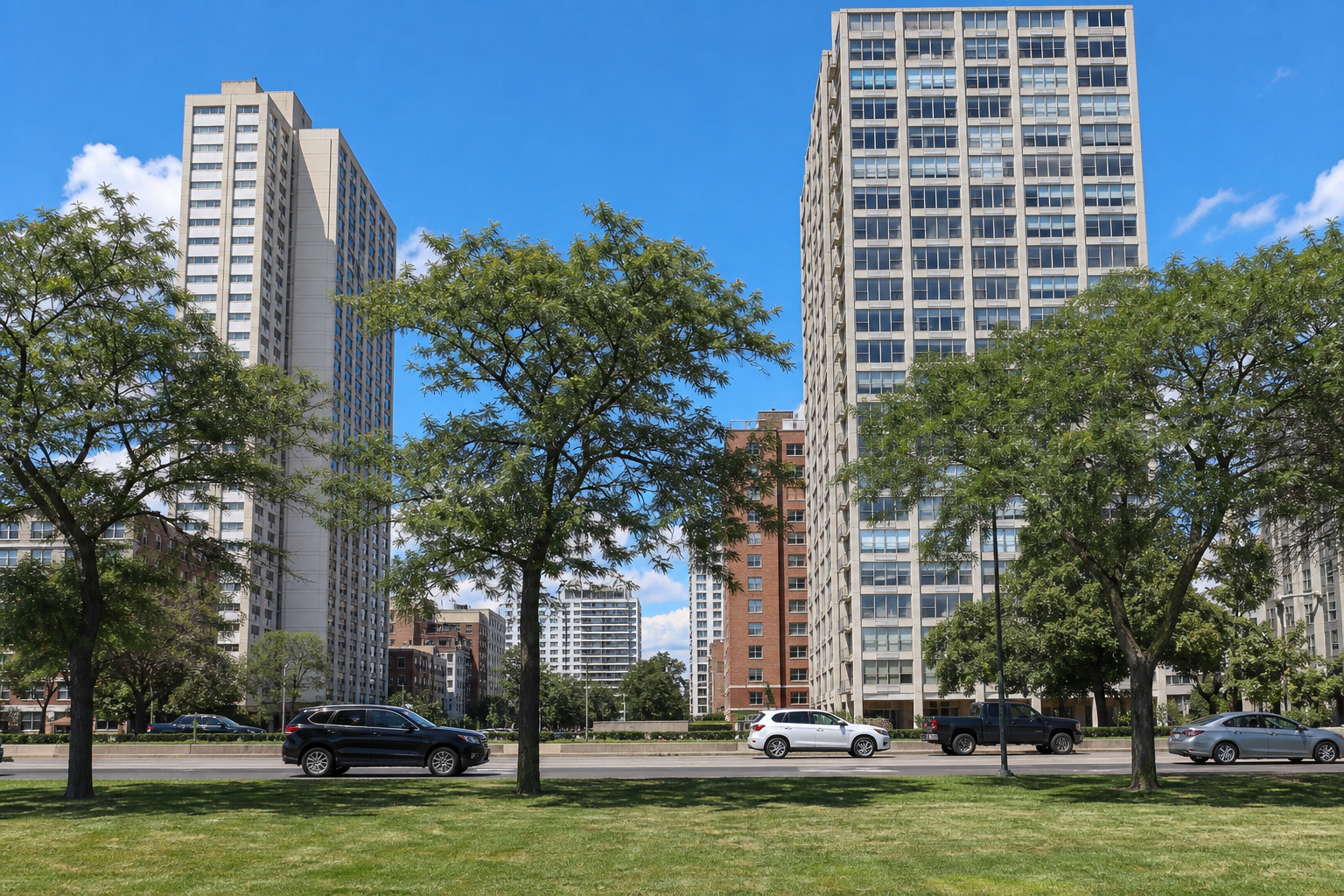

Sixty-nine Chicago condominium buildings bought in bulk from 2018 through 2024, five or more units by one company or on one deed, are no longer condominiums on the Assessor’s rolls, and the 2026 parcel nearest where each stood is classed as an apartment building or a two-to-six-flat. That is the pattern a deconversion would leave: the sale of a whole condominium to a buyer who, in the state regulator’s words, “will turn the condominium units into rental apartments.” Forty-six of the 69 were bought in 2018 through 2020, and one in 2024. A rule the City Council added in September 2019 requires the approval of at least 85 percent of a Chicago condominium’s unit owners for such a sale; elsewhere in Illinois, state law sets 75 percent for buildings of four or more units.
County sales file (wvhk-k5uv) as updated September 15, 2026, and the Assessor’s 2026 parcel rolls (nj4t-kc8j) · read October 1, 2026 · the matching of purchases to buildings, and the counts, are oursHow a building sold whole shows up in the records
The county’s sales file lists recorded sales parcel by parcel. A building sold whole can appear there in one of two ways: as one sale per unit, which the file keeps with ordinary home sales, or as one sale covering many units, which the file flags as a multi-parcel sale. We looked for the pattern each leaves. One is a company that bought five or more units of one building, one deed at a time, a building being the units whose parcel numbers share their first ten digits. The other is a single deed that carried five or more condominium units. Neither pattern shows that every unit changed hands. Both are read under the county’s screens for arm’s-length, or market, sales, and together they find 179 buildings since 2018. The Assessor’s 2026 rolls then show which are still condominiums. In 102, unit parcels remain. In 69, the unit parcels are gone and the parcel at or nearest the building’s former location is classed as an apartment building, 59 in the classes for seven or more units and 10 as two-to-six-flats. The other eight show something else: a house, vacant land, another kind of property, or condominium parcels under new numbers. Purchases of five or more units followed by that change on the rolls are the pattern a deconversion would leave; the record does not hold the owners’ votes or the sale contracts that would confirm one.
How quickly do the rolls show it?
By the next tax year, usually. Of the 69 buildings, 42 left the rolls as condominiums in the first tax year after their last purchase and 58 within two years; the slowest took six. The 2026 rolls therefore show most of the buildings sold whole through 2024, and some sold in 2025 may not appear yet.
Did the pattern continue after Chicago’s 85 percent rule?
Yes. Of the 69 buildings, 34 were bought mostly in 2018 or 2019, and 35 later: 12 in 2020, eight in 2021, nine in 2022, five in 2023 and one in 2024. The City Council added the 85 percent rule to the Municipal Code on September 18, 2019. Our reading: the pattern outlasted the higher bar and turned up less often after 2022. The records cannot say whether the rule had any part in that, or how many purchases of 2025 the rolls have yet to show.
Where were they?
Along the North Side lakefront, mostly. The six community areas on the North Side lakefront, Rogers Park, Edgewater, Uptown, Lake View, Lincoln Park and the Near North Side, hold 43 of the 69 buildings and 2,483 of the 3,202 units bought in these purchases. The Loop holds one, the River City complex at its south end, 442 units, whose sale our page on who buys Chicago homes documents. The rest are spread over 15 other community areas, none with more than three.
| Community area | Buildings | Units bought in those purchases |
|---|---|---|
| Near North Side | 7 | 1,102 |
| Edgewater | 8 | 573 |
| Loop | 1 | 442 |
| Lake View | 8 | 337 |
| Uptown | 7 | 271 |
| Rogers Park | 7 | 112 |
| Lincoln Park | 6 | 88 |
| South Shore | 3 | 74 |
| Hyde Park | 1 | 43 |
| Austin | 3 | 24 |
| Grand Boulevard | 2 | 20 |
| Logan Square | 2 | 20 |
| Albany Park | 2 | 18 |
| West Town | 3 | 15 |
| Humboldt Park | 2 | 12 |
| Chatham | 1 | 11 |
| Woodlawn | 1 | 10 |
| West Garfield Park | 1 | 8 |
| North Lawndale | 1 | 6 |
| Belmont Cragin | 1 | 6 |
| Lower West Side | 1 | 5 |
| Near West Side | 1 | 5 |
Why did companies’ share of condominium purchases halve?
Mostly because of these purchases. In 2018 and 2019 companies bought 2,978 condominiums in the county’s ordinary sales, and 1,798 of those were units of a building where the same company bought five or more. In 2024 and 2025 they bought 1,264, and 102 were. Their other condominium purchases barely changed: 1,180 in the first period and 1,162 in the second, 4.7 and 5.8 percent of all condominium sales. In the four areas where the company share of home purchases fell furthest, the Loop, the Near North Side, Edgewater and Uptown, these purchases account for the drop: outside them, companies bought 502 homes there in 2018–19 and 554 in 2024–25. On the Near North Side alone, companies bought 610 units this way in the first period and 17 in the second, against 301 and 308 other homes. Our area pages for the Near North Side, Edgewater and Uptown, and our gentrification-signals analysis, report the fall in the company share; these purchases are most of it.
Have buyers stopped buying whole buildings?
The record cannot say. A whole building can change hands on one deed, and since 2022 none of the file’s deeds carrying five or more condominium units names its buyer. The file holds 109 deeds since 2018 that each carried five or more condominium units, eight of them in 2025 with 371 units. Of the 88 buildings with such a deed, 30 are among the 69 above and 53 still have unit parcels on the rolls, which is also what the sale of a whole building from one investor to another would leave. The other five show vacant land at two, a house at one, other property at one and condominium parcels under new numbers at one.
What does it take to sell a condominium whole?
| Where the building is | Owners needed to approve the sale | Where the rule is written |
|---|---|---|
| Chicago | At least 85 percent of unit owners | Municipal Code of Chicago, 13-72-085 |
| Elsewhere in Illinois, four or more units | At least 75 percent | 765 ILCS 605/15 |
| Elsewhere in Illinois, three units | At least two-thirds | 765 ILCS 605/15 |
| Elsewhere in Illinois, two units | A majority | 765 ILCS 605/15 |
In both texts the vote binds every owner. An owner who did not vote for the sale and files a written objection with the board or manager within 20 days after the meeting that approved it is entitled to the greater of two amounts: the unit’s value by a fair appraisal, or the balance of the loan taken to buy or refinance it, less any unpaid assessments either way. The owner is also due reasonable relocation costs, figured as under the federal Uniform Relocation Assistance and Real Property Acquisition Policies Act of 1970. When an objecting owner and the buyer disagree on the value, each names an appraiser, the two name a third, and two of the three decide. The state regulator’s explainer, How Does a Deconversion Work?, notes that each vote counts in proportion to the unit’s share of ownership in the common elements, with one exception in the act, and Chicago’s section says the state act governs the sale except where the section provides otherwise.
One change is pending. A bill filed in the Illinois Senate on February 7, 2025, SB2125, would require the vote to take place at one meeting, with 72 hours’ notice to every owner. Its last action, on April 11, 2025, sent it back to the Senate’s Assignments committee. The state regulator also posts Chicago’s condominium chapter in full.
Known limits
A purchase counts only if one company bought five or more units of a building one deed at a time, with its name written the same way each time, or if a single deed carried five or more units. A buyer who took units one deed at a time through a land trust, several companies or a person’s name would be missed, so every count here is a floor for purchases that match these patterns, and a match is not proof of a deconversion. A building is the set of units whose parcel numbers share their first ten digits, and a complex on several such numbers counts as several buildings. The rolls record how the Assessor classes a parcel and say nothing of how it is used. Parking and storage parcels the Assessor flags are left out of every unit count. Nothing here says why owners voted to sell, what they were paid, or what became of the people who lived there.
- Sales Assessor Parcel Sales (wvhk-k5uv), Chicago’s townships, 2018 through July 2026, under the county’s screens for arm’s-length sales, read October 1, 2026 on the reading of September 30 (file updated September 15, 2026). Buyer names are compared in capitals with punctuation removed and sorted into companies by the words in them, as on our who-is-buying page; no name is published.
- Rolls Assessor Parcel Universe (nj4t-kc8j), tax year 2026 for the classes, and the year each building was bought for where it stood. When a building’s unit parcels are gone, the class reported is that of the 2026 parcel nearest its former location, within 40 meters.
- Rules The Chicago section from the state regulator’s copy of the chapter, the state section from the General Assembly’s site, the regulator’s explainer and the bill’s status page, all read October 1, 2026; each sentence summarized was checked against the text.
Computed by KCM Desk from records read October 1, 2026. Nothing here is legal advice. Human-guided and edited — about this desk. If you spot an error, corrections come first.
Related Keep Chicagoland Moving coverage
- Chicago Housing, by the Numbers
- Who Is Buying Chicago? The Buyer’s Name on 245,849 Deeds: Companies Bought 13 Percent of Homes and 46 Percent of Those Resold Within Two Years
- Cook County’s Condo Count Grew 73 Percent From 1999 to 2010, by the Assessor’s Count — Then Leveled Off: 372,354 Units in 2025, 63 Fewer Than in 2010
- Where Chicago’s Gentrification Signals Are Active: East Garfield Park, New City and North Lawndale Show Four of Five. Logan Square, Avondale and the Lower West Side Show None.
- Near North Side, by the Numbers: 1,836 Condominium Sales in 2025, the Most in Chicago, and Company Buyers Down From 21.6 to 8.6 Percent of Home Sales
- Edgewater, by the Numbers: Company Buyers Fell From 20.4 to 8.4 Percent of Home Sales, the Third-Largest Drop in Chicago, and the Median Condominium Rose to $235,000
- Uptown, by the Numbers: The Median Two-to-Six-Flat Nearly Doubled to $1.23 Million, and Company Buyers Fell From 15.5 to 6.6 Percent, the Fourth-Largest Drop in Chicago
- Lake View, by the Numbers: 1,030 Fewer Two-to-Six-Flats Than in 2006, 683 Now Classed as Houses and 289 as Condominiums, and the Second-Most Condominium Sales in Chicago
- Chicago’s Tax Rolls Show 7,875 Fewer Two-to-Six-Flats Than in 2006. Of the 13,049 Parcels That Left the Count, 6,208 Are Now Classed as Single-Family Houses.