
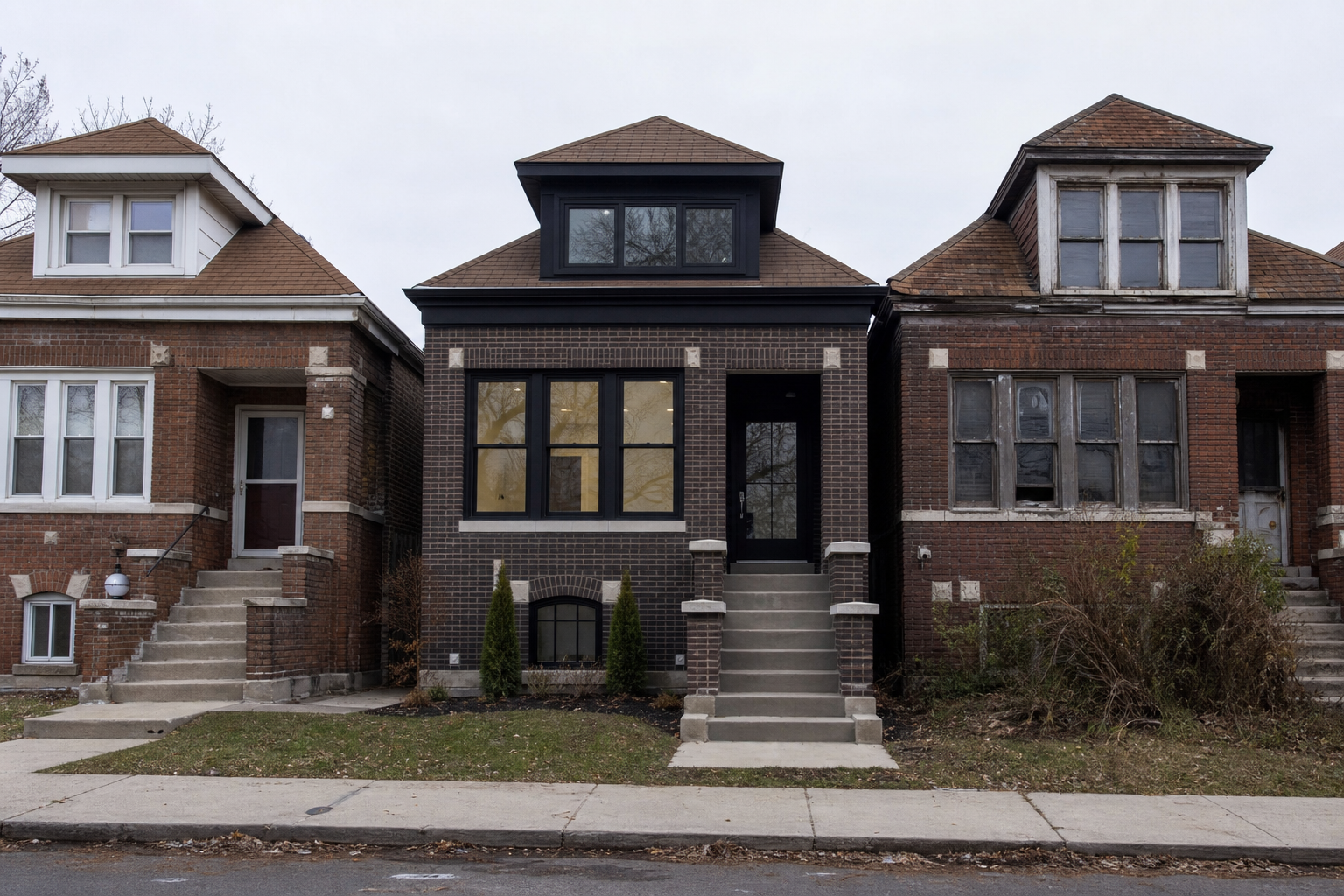

Companies bought 13 percent of the Chicago homes sold from 2018 through 2022 and 46 percent of the ones their buyers resold within two years. Both figures come from the buyer names on Cook County’s recorded sales. The names also show that “company buyer” covers very different activity: a company that buys every unit in one condominium building, a company that buys one property at a time on hundreds of different parcels, a nonprofit that takes over distressed buildings with the city, and a relocation firm that buys a transferred employee’s house and resells it. This page counts each from the names on the deeds.
Cook County Assessor sales file as updated September 15, 2026: 245,849 recorded Chicago home sales since 2018, with the buyer and seller named on each · computed September 30, 2026Correction, September 30, 2026: this page was published on July 18, 2026, and five things in it were wrong. It counted 9,704 homes bought from 2018 through 2024 and resold within two years. Two faults made that number too low and the period too long: names were matched without allowing for differences in spacing, which hid about a third of the matches, and purchases of 2023 and 2024 were included although their two years had not run out. The count here covers purchases through 2022. It said the company share of those resales was “roughly double” the company share of all purchases; it is 3.5 times. Its table of single-building buyers listed a company with 284 unit deeds that were parking spaces in a garage, which the Assessor flags and this page now leaves out. It counted purchases made in the name of a land-trust company as company purchases, while noting that the company is a trustee; trustees are now counted as trusts. And it said about one purchase in six in 2026 had a company buyer, 16.1 percent, the highest in nine years; that compared five months with full years, and the full-year high is 2018’s 15.1 percent.
How many buyers were companies
Of the 245,849 recorded sales, 32,884 name a company as the buyer, 13.4 percent. They are spread over 16,153 different company names, which understates how concentrated the buying is: an investor who puts each property in its own company appears here as many small buyers, and the deeds give no way to connect them. By year, the company share fell from 15.1 percent in 2018 to 11.1 percent in 2020 and was back to 14.8 percent in 2025. Our report on gentrification signals has the year-by-year table and the areas where the share is rising.
Companies that bought one building, unit by unit
| Buyer named on the deeds | Unit deeds | Area, year |
|---|---|---|
| EWFM River City SPE LLC | 442 | Loop, 2018 |
| Two East Oak Realty LLC | 291 | Near North Side, 2019–20 |
| 1400 NLSD Owner LLC | 288 | Near North Side, 2019 |
| 5815 N. Sheridan LLC | 188 | Edgewater, 2018 |
| 1140 N. LaSalle Owner LLC | 182 | Near North Side, 2018 |
| Duplex Tower LLC | 154 | Edgewater, 2023 |
| Barry Quad LLC | 110 | Lake View, 2021 |
| East Chestnut Realty LLC | 102 | Near North Side, 2020 |
The companies with the most deeds in the file each bought inside a single building. That pattern matches a condominium deconversion, in which an investor buys out the owners and the building becomes rental apartments again, and two of the eight are documented as deconversions in news reports. The 442 deeds in the name of EWFM River City SPE LLC are the River City complex at the south end of the Loop, sold for $90.5 million in December 2018 in what The Real Deal called the largest deconversion in the city to that point. The 288 deeds of 1400 NLSD Owner LLC are 1400 North Lake Shore Drive, bought for $107 million, by the same outlet’s report. These purchases are large and few. The deeds alone do not show what became of the other six buildings, but the tax rolls do: by tax year 2026 all eight had left the rolls as condominiums, and the parcel nearest each is classed as an apartment building of seven or more units, by our count of condominium buildings bought in bulk. The eight are in four community areas, the Loop, the Near North Side, Lake View and Edgewater, and they are a different activity from the parcel-by-parcel buying below.
Companies that bought one property at a time
| Buyer named on the deeds | Purchases | Parcels |
|---|---|---|
| Grandview Capital LLC | 400 | 398 |
| SEEM Group LLC | 131 | 131 |
| Commercial Acquisitions LLC | 119 | 119 |
| Illinois Land Investment Inc. | 113 | 113 |
| Construction Rehab Services LLC | 86 | 86 |
| Tentazione LLC | 76 | 70 |
| BMW Props LLC | 75 | 75 |
| Connolly Capital LLC | 74 | 74 |
The second kind of company buyer has purchases spread over many different parcels. Grandview Capital LLC is named on 400 purchases on 398 different parcels, the most of any such buyer in the file. In Englewood, 1878 Inc. is named on 16 purchases and Illinois Land Investment Inc. on 14, with 9 more recorded under the same name without “Inc.” In Auburn Gresham the most active for-profit name is Connolly Capital LLC, with 21. These counts are floors. A buyer that holds each house in a separate company is split across many rows, and nothing on a deed joins them.
Two busy names are left off the table because neither is an investor building a portfolio. Community Initiatives, Inc., with 241 purchases on 240 parcels, is the affiliate of the nonprofit Community Investment Corporation that runs the Troubled Buildings Initiative with the City of Chicago: it steps in on distressed buildings, often as a court-appointed receiver, and makes court-ordered repairs. Cartus Financial Corporation, with 74 purchases, is a relocation company, which takes title to the home of an employee who is being transferred and then sells it. A company name on a deed gives the buyer’s legal form and nothing about its purpose.
Homes bought and resold within two years
| Year bought | Homes bought | Resold | Share |
|---|---|---|---|
| 2018 | 32,525 | 2,719 | 8.4% |
| 2019 | 30,586 | 2,522 | 8.2% |
| 2020 | 29,273 | 2,037 | 7.0% |
| 2021 | 37,014 | 2,203 | 5.9% |
| 2022 | 31,712 | 1,962 | 6.2% |
| 2018–22 | 161,110 | 11,443 | 7.1% |
How often is a Chicago home bought and sold again within two years? Match the buyer on one deed to the seller on the next deed for the same parcel, and 11,443 of the 161,110 homes bought from 2018 through 2022 were resold by their buyer within 730 days, 7.1 percent. Drop the name test and count any second sale of the parcel within 730 days, and the number is 16,876. The difference is resales where the two names do not match, which takes in spelling differences and sales by a lender or an heir. This page uses the matched count, which is the lower one.
Companies were the buyer in 45.5 percent of those quick resales and in 13.0 percent of all purchases in the same five years, a ratio of 3.5 to one. The median quick resale sold for $109,901 more than its purchase price after 343 days. That figure is the gap between two recorded prices and cannot be read as profit: the deeds show nothing of what was spent on repairs, financing or sale costs in between.
Purchases of 2023 are left out of the total because their two years run into 2025, a year the county is still recording. So far 1,891 of the 25,359 homes bought in 2023 show a resale by the buyer, 7.5 percent, and the count of resales can still rise as 2025 sales are recorded.
Where are quick resales most common? In five areas on the far South Side: Calumet Heights (18.0 percent), Washington Heights (17.9 percent), Auburn Gresham (17.0 percent), West Pullman (16.3 percent) and Roseland (15.4 percent). There, about one home in six bought from 2018 through 2022 was resold by its buyer within two years. The lowest rates are downtown: 2.5 percent on the Near West Side, 2.6 in the Loop and 2.9 on the Near South Side. In all five of the top areas the median house price started below the citywide median in 2019 and has risen faster than the city’s 39 percent since, by the figures in our analysis of recorded sale prices. A deed cannot say whether a given resale followed a full renovation of a vacant house or a quick markup, and this page does not say either.
Known limits
Names are matched as written. Two spellings of one company count as two buyers unless they differ only in spacing, punctuation or a trailing description of the company, and companies under common ownership cannot be joined at all, so every count of purchases by one buyer is a floor. A name is sorted as a company by the words in it, and a business that records no such word is counted as a person. Trusts are counted apart from companies, and some investors buy through trusts. The quick-resale count requires the same name on both deeds, which leaves out owners who moved a property into another name before selling. Nothing here measures profit, rent or who lived in a home.
- Source Cook County Assessor, Parcel Sales (wvhk-k5uv), as updated September 15, 2026: 245,849 recorded sales of houses, condominiums and two-to-six-flats in Chicago since January 2018 that pass the Assessor’s arms-length screens and cover a single parcel. 3,522 sales of condominium parcels flagged as parking spaces, storage units or common areas are left out.
- Sorting the names In this order: banks and government bodies; trusts and trustees; companies, by markers such as LLC, Inc., Corp. and words such as Properties, Holdings or Capital; everyone else. A company’s purchases are grouped under its name up to the first corporate marker.
- One building or many A company is listed as a single-building buyer when all of its purchases share one base parcel number, and as a parcel-by-parcel buyer when at least 60 percent of its purchases are on different base parcels.
- Quick resales The same parcel sold again within 730 days, with the first sale’s buyer named as the second sale’s seller. Purchases through December 31, 2022 are counted, so that each two-year window closes in 2024, the latest year whose sales count has stopped changing. The price gap and the holding period are medians over resales whose first price was above $20,000. Area shares are shown where at least 300 homes were bought.
Computed by KCM Desk from the county sales file read September 30, 2026. First published July 18, 2026; recomputed and rewritten September 30, 2026. Names are given as they appear in public records, and a pattern of purchases is not an allegation of wrongdoing. Human-guided and edited — about this desk. If you spot an error, corrections come first.
Related Keep Chicagoland Moving coverage
- Chicago Housing, by the Numbers
- Chicago Houses That Closed in June Sold for 12 Percent More Than January’s in the Same Area, 2018 to 2024. Condominium Closings Ran Twice as High in May
- Where Chicago’s Gentrification Signals Are Active: East Garfield Park, New City and North Lawndale Show Four of Five. Logan Square, Avondale and the Lower West Side Show None.
- Chicago’s Tax Rolls Show 7,875 Fewer Two-to-Six-Flats Than in 2006. Of the 13,049 Parcels That Left the Count, 6,208 Are Now Classed as Single-Family Houses.
- What a Chicago Home Actually Sold For: 245,849 Deeds Since 2018, All 77 Community Areas
- At Least 1,532 Chicago Homes Sold for $100,000 or Less in 2025. Lenders Wrote 289 Mortgages That Size.
- Most Chicago House Appeals Filed Without a Lawyer Won. Most Filed With One Did Not.